What is a booster pump, and who looks after it?
Who pays, usually: The association or landlord normally maintains and pays for a booster pump, since it serves many homes. Condo owners fund it through common charges, and the declaration has the final word.
Filed under Probably the association's
A booster pump in an apartment building raises incoming water pressure so upper floors get usable flow, and building staff or the association, not individual residents, normally looks after it.
From the Whose Pipe Is It? desk. Sources last checked November 3, 2026. .
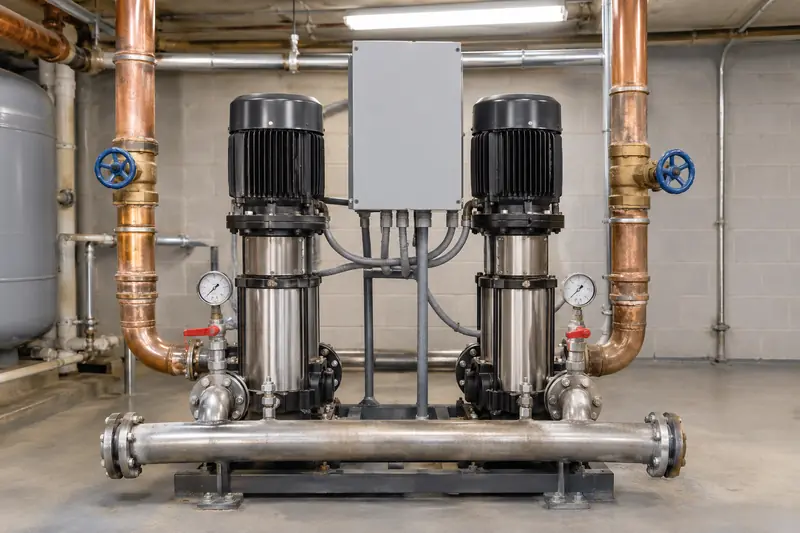
City water arrives at the street with only so much push. It is often enough for the lower floors and not for the upper ones. A booster pump, usually kept in a basement or mechanical room, adds the missing push. You will probably only think about it when it stops, or starts humming through your bedroom wall.
The plumbing code recognizes this. The International Plumbing Code, as adopted in North Carolina, requires a water pressure booster system when pressure at the fixtures would otherwise fall short. Other places use other codes, so your building department is the one to ask about local wording.
Are all buildings set up the same way?
No. In broad terms there are two arrangements. In one, pumps feed the pipes directly and controls speed them up or call on more pumps as demand rises. In the other, pumps lift water to a tank on the roof and gravity delivers it downward. Many mid-size buildings need neither, and some need both at different heights. The low-rise versus high-rise differences explain why.
What does a failing or noisy pump look like from upstairs?
You cannot diagnose a pump from your apartment, and nobody expects you to. You can report what you notice accurately, and that is genuinely useful to whoever services it.
| What you notice | What it can mean | Who hears about it, and how fast |
|---|---|---|
| Upper floors are weak or dry, lower floors are fine | Pump down, or tank running low | Staff or the emergency line, now |
| Flow surges and fades at the faucet | Pump cycling, or a controls problem | Staff, the same day, with the times |
| A steady hum or vibration near the mechanical room | Pump running, or worn mounts | The manager, in writing |
| Water fades during a power cut | The pump has no power | Staff, once they can be reached |
A hum is not automatically a fault, since pumps make noise when they run. The useful detail is change: louder than last month, running all night when it never did, or starting and stopping every few seconds. If you are hearing water in the wall rather than a machine, try the night listening checks. If your weak water is confined to the top of the building, the upper-floor pressure page covers what else it might be.
Who actually services it?
Usually a contractor hired by the association, the management company or the landlord. A pump serving many homes is the textbook shared item, though documents decide it rather than logic. Residents have no business in the pump room, and no reset, valve or switch down there is yours to operate, even if the door is open and the water is off.
If you own
Ask the manager or board for the pump's service records and whether replacement is planned for in reserves. In Florida only, the structural reserve study required for residential buildings of three or more habitable stories lists plumbing, though it does not name pumps. A large replacement can surface as an assessment, and how riser and equipment assessments work is worth reading before the vote.
If you rent
A building's pump is not your repair to arrange or pay for. Report the symptom to the landlord or manager in writing, with dates. If noise is the complaint, describe when it runs and which rooms it reaches, because a vague complaint about noise is easy to set aside.
The short of it
A booster pump makes upper floors usable, and it belongs to whoever runs the building. Your job is to notice changes and report them with times, not to go near the equipment.
Asked next
Why does the water stop when the power goes out?
Pumps need electricity, so a building without backup power may lose pressure on the floors that rely on them. Lower floors can sometimes keep water from street pressure alone. Ask your manager how your building behaves in an outage before you are in one.
Can one resident ask to see the pump maintenance log?
A condo owner can ask. Your bylaws and any state records rules decide what the board must hand over. A renter can ask too, but has less standing, so a written description of the problem is usually the better route.
Does a booster pump make water pressure dangerous on lower floors?
It should not in a properly set up system, since most codes cap pressure at 80 psi, or 85 in New York City, and regulators keep floors within that. If you live low in a pumped building and hear banging, mention it to staff. It may have nothing to do with the pump, but they should know.
Read it yourself
- International Plumbing Code 2021 as adopted by North Carolina, chapter 6: booster requirement, code text as displayed by a third-party code site, read Nov 3, 2026.
- NYC Health, rooftop drinking water tank inspection results: annual inspection, hired inspector, public lookup, read Nov 3, 2026.
- NYC Health, water tank inspection FAQ: January 15 reporting deadline, read Nov 3, 2026.
- California Civil Code 4775: restoring interrupted services and the 14-day start, archived copy of the official page, captured Sep 14, 2026, read Nov 3, 2026.
- Florida Statutes 718.112: plumbing on the reserve study list, read Nov 3, 2026.
- EPA WaterSense, Service Water Pressure technical sheet: most codes at 80 psi, read Nov 3, 2026.
- NYC Plumbing Code 2022, chapter 6: the 85 psi figure, code text as displayed by a third-party code site, read Nov 3, 2026.