Why is my water pressure so weak on an upper floor?
Who pays, usually: The association or landlord, when every upper floor is weak, because pumps, tanks and risers tend to be shared. A problem confined to one fixture in your unit is a different matter.
Filed under Probably the association's
Low water pressure in an apartment building's upper floors usually comes from height, a booster pump or tank not keeping up, or old shared pipes, and the pattern of the weakness points to which.
From the Whose Pipe Is It? desk. Sources last checked November 3, 2026. .
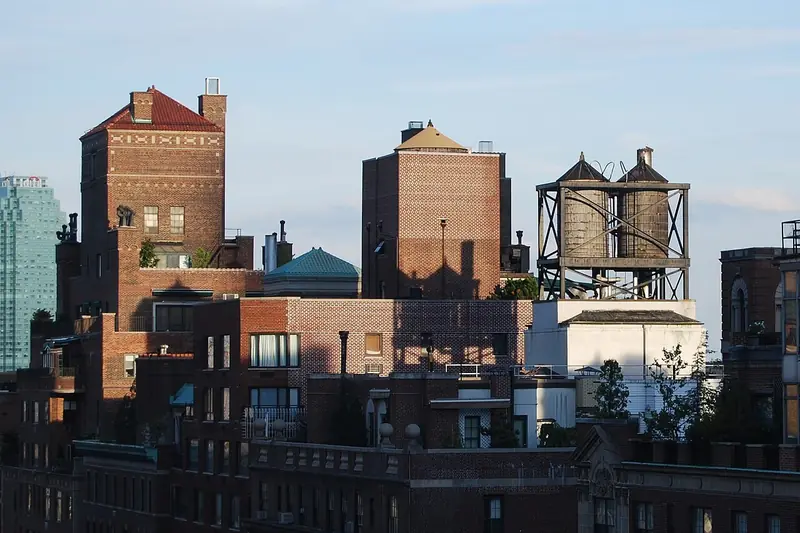
Water has weight, and lifting it uses up pressure. EPA's figure is 0.433 psi for every foot of height. By simple arithmetic, a 10-foot floor uses about 4.3 psi, 50 feet about 21.7 psi and 100 feet about 43.3 psi, before any faucet has opened.
- One floor, 10 feetabout 4.3 psi
- Five floors, 50 feetabout 21.7 psi
- Ten floors, 100 feetabout 43.3 psi
Height explains why the problem exists. It does not excuse it, because a tall building is supposed to make up the difference. The International Plumbing Code, as adopted in North Carolina, calls for a booster system when pressure falls short of its minimums. That table lists 8 psi of flow pressure at most fixtures and 20 psi at a balanced-pressure shower or a tank toilet. Your city may use a different code, so treat those as an example.
Why not just send more pressure from the bottom?
Because the lower floors would get it too. EPA notes that most US codes call for a regulator where pressure tops 80 psi, and New York City's figure is 85. WaterSense recommends 45 to 60 psi for incoming service, which is a target and not a promise for your shower on a high floor.
So many tall buildings are divided into pressure zones, each fed its own way. The top of a zone is often where the weakest water is, which is why two floors can have noticeably different showers. How the pumps push water up is covered in what a booster pump does.
What does the pattern tell you?
| What you notice | What it points toward | Where to go next |
|---|---|---|
| Every fixture is weak, and neighbors nearby say the same | The shared supply: pump, tank or riser | Building staff or the manager |
| Bad at breakfast and dinner, fine late at night | Demand outrunning a tired pump or narrowed pipes | Staff, with your notes on timing |
| It started today across the whole building | A shutdown, pump fault or utility work | Planned shutdown notes |
| Every fixture in your home, but neighbors are fine | Something on your own branch or unit valve | Which valves are yours |
| One faucet only | That faucet | The one-faucet checks |
| Hot side only | The hot-water system | Hot water delays |
Where do old pipes come in?
In older buildings, the usual suspicion is the inside of the pipe. Older steel lines are commonly described as narrowing with buildup, which shows up as weak flow even when the pump is healthy. That is general trade experience, not a measured figure, and only testing or opening the pipe can confirm it. If your building is talking about this, what older pipes can mean and how risers work are the next reading.
Build a short record before you complain
- Note which fixtures are weak, and whether it is the hot side, the cold side or both.
- For several days, write down the time whenever it is at its worst.
- Ask a neighbor above you, one below and one on your floor whether they see the same thing.
- Send the notes to the manager or board, and ask three things: is there a booster, when was it last serviced, and which pressure zone is your floor in.
Leave pumps, risers and building valves to staff, however tempting a nearby handle looks. Turning one can affect every home on the line.
If you own
Equipment that serves many units is usually a common element, so this is normally a board item. Check how your declaration defines common elements and read the maintenance article, then ask for the service history in writing. Fitting your own pump to a shared line is not something to try; raise it with the board.
If you rent
Tell the landlord in writing, with your dates and times. The building's supply is theirs to deal with, not yours to arrange or pay a plumber for. Whether weak pressure counts as a repair they must make depends on your state and lease, and no water at all is a stronger complaint than slow water. See what falls to your landlord.
The short of it
Height creates the problem and building equipment is meant to solve it. If neighbors share your weak water, it is very likely not yours to fix, and a few days of written notes will get a better answer than a general complaint.
Asked next
Is there a legal minimum water pressure for apartments?
Plumbing codes set minimum flow pressures at fixtures, such as the 8 and 20 psi figures in the code table above. Those are modest numbers, and adoption varies by place. Your local building department can tell you which code applies and how it treats an existing building.
Will a new showerhead fix weak upstairs pressure?
It can change how the spray feels, but it cannot add pressure the supply is not delivering. It is worth trying only if the shower alone is weak. If every tap is weak, the answer lies upstream of your bathroom.
Why is the water pressure fine at 2 a.m.?
Fewer homes are drawing water, so the pump and pipes have less to keep up with. A strong night and a weak morning is a useful clue, so write it down. It suggests the system works but struggles under load.
Can lower floors have too much pressure?
Yes. Most codes top out at 80 psi, New York City's ceiling is 85, and buildings use regulators to stay under those. Too much pressure can bring its own noises and wear, which is a separate problem from yours.
Read it yourself
- EPA, Cross-Connection Control Manual: the 0.433 psi per foot figure, read Nov 3, 2026.
- EPA WaterSense, Service Water Pressure technical sheet: most codes at 80 psi and the 45 to 60 psi recommendation, read Nov 3, 2026.
- International Plumbing Code 2021 as adopted by North Carolina, chapter 6: section 604 flow pressures and the booster requirement, code text as displayed by a third-party code site, read Nov 3, 2026.
- NYC Plumbing Code 2022, chapter 6: the 85 psi figure, code text as displayed by a third-party code site, read Nov 3, 2026.