Where are the water shutoffs in my unit?
Who pays, usually: Small valves serving your fixtures often fall to the owner, or to the landlord in a rental; valves on risers or serving others are usually the association's or building's, though documents vary.
Filed under Probably yours
The water shut off valve in your apartment is most often several small valves, one under each sink and behind each toilet, and sometimes one or two that serve the whole unit behind a panel or in a closet.
From the Whose Pipe Is It? desk. Sources last checked November 3, 2026. .
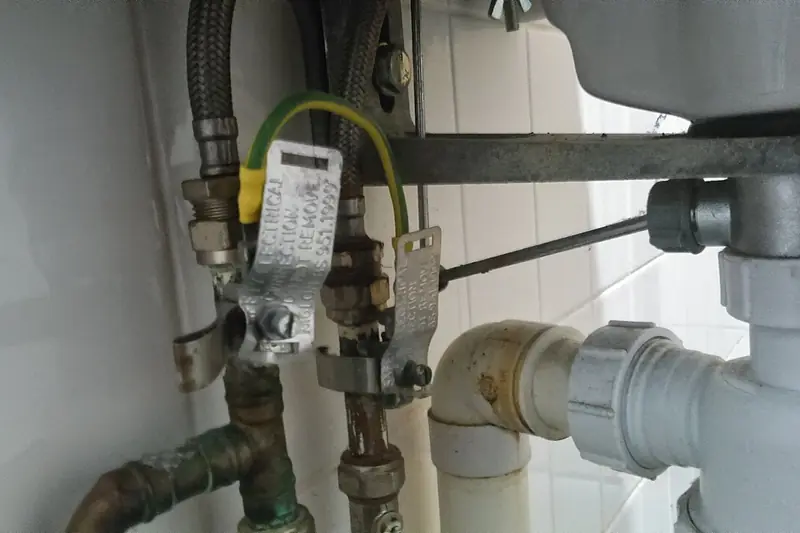
Find them on a calm afternoon. You don't want to be reading this with a flashlight and a wet floor, so walk through your unit once and look. What follows is general practice, because no utility or EPA how-to for these valves was found, and buildings differ.
| Where | What you'll usually find | What it stops |
|---|---|---|
| Under each sink | Two small valves, hot and cold, on pipes coming out of the wall | That faucet only |
| Behind or beside the toilet | One small valve, low down | That toilet only |
| Behind the washer | Two valves or a single lever, often in a recessed box | The washer only |
| Top of a unit water heater | Often a valve on the cold line going in | The heater's supply, if the building says it's yours to use |
| Access panel, closet or above a ceiling tile | Sometimes one or two valves for a bathroom group or the whole unit | Ask staff; it might be yours, or might not |
The small valves are called stops. Most turn clockwise to close, with a small oval handle, or a quarter turn on a lever. Don't be surprised if you find no valve for the whole unit. Many apartments don't have one, particularly when a unit is fed by more than one riser.
Whose valves aren't they?
This is the part to be clear about. Riser valves, main shutoffs, booster and pump room valves, and anything in a hallway closet, basement or mechanical room belong to building staff. Leave them for staff. Closing one takes water from your neighbors, and reopening it badly can make things worse. If you find a valve and can't tell who it serves, treat it as the building's until someone says otherwise.
Should you test them?
Gently, and if you rent, ask your landlord first. Stops can sit untouched for decades and grow stiff, and old ones sometimes weep when moved. Better to learn that on an ordinary day.
Trying a fixture stop
- Pick a time when help could be reached, not a Saturday night.
- Put a towel below the valve and have a bucket close by.
- Turn the handle slowly toward closed, feeling for resistance. If it won't turn, don't force it. Call a plumber or the super.
- Open the faucet to see whether the water stops, then close the faucet.
- Open the stop again slowly and check the valve and its stem for drips. A new drip means a call to a plumber or the super, and a note to whoever is responsible.
No wrench for extra force, either. A snapped stem is a worse problem than a stiff one.
What should you ask the building?
Send a short message to the manager or super:
- Is there a valve for my whole unit, or a group of fixtures? Where is it?
- Is that valve mine to use in an emergency, or only staff's?
- Which risers feed my unit?
- Who takes calls after hours, and at what number?
Write the answers down and tape them inside a kitchen cabinet. New York City's water department gives the same basic direction: in an apartment building, check with your building supervisor.
What do you do when something's actually leaking?
Close the nearest valve you know is yours. Then ring staff or the emergency line, even if the water has stopped, so someone can check what's below. If water is near outlets or appliances, stay out of it. A breaker is fine only from dry ground; failing that, leave it and tell staff from a safe place. The first-hour page covers the rest. A wet wall shared with a neighbor or water you can hear running has its own page.
If you own
Check who owns which valves in your declaration's maintenance article, because a failing stop may be your job even if the line behind it isn't. Have a plumber replace seized stops while there's no emergency. Replacing a stop often means shutting water at a riser, and staff do that.
If you rent
Learn where the valves are on your first day. You can close a fixture stop in a leak. Stiff, leaking or missing valves are for your landlord, so report them in writing and keep a copy. Don't replace one yourself.
The short of it
Your valves are the small ones that serve your own fixtures, plus any the building confirms are yours. Find them now, and if one won't turn, don't force it. Risers and everything beyond them belong to staff.
Asked next
What if my unit has no main shutoff?
That's common. In an emergency, close the fixture stop if the leak is after it, and otherwise call the emergency line at once. Ask whether one could be added during the next plumbing project.
Why does water keep coming after you close the stop?
A little may drain from the pipes, which should stop in a moment. If it keeps flowing, the stop may be worn or the leak may be upstream of it. Call staff or the emergency line and put down towels and buckets if it's safe.
Which way does a stop turn?
Most close clockwise, and a quarter-turn lever usually closes when it sits across the pipe. Go by whether the water stops, and never force one.
Read it yourself
- NYC DCAS fire safety flyer, January 2026: leave sprinkler valves to building staff and report leaks, read Nov 3, 2026.
- NYC Department of Environmental Protection, water shut-offs: apartment residents check with the building supervisor, read Nov 3, 2026.
- CDC, protect yourself from electrical hazards: power and standing water, read Nov 3, 2026.