There's a wet spot on a wall between units. Whose pipe is it?
Who pays, usually: It depends on what the pipe serves. Shared lines are usually the association's, one-unit lines vary by declaration, and rentals generally go through the landlord, so find the source before anyone assigns the bill.
Filed under Not clear yet
With pipes in condo walls, who is responsible depends on which line is leaking and what it serves, so a wet shared wall has to be traced before anyone can honestly say whose it is.
From the Whose Pipe Is It? desk. Sources last checked November 3, 2026. .
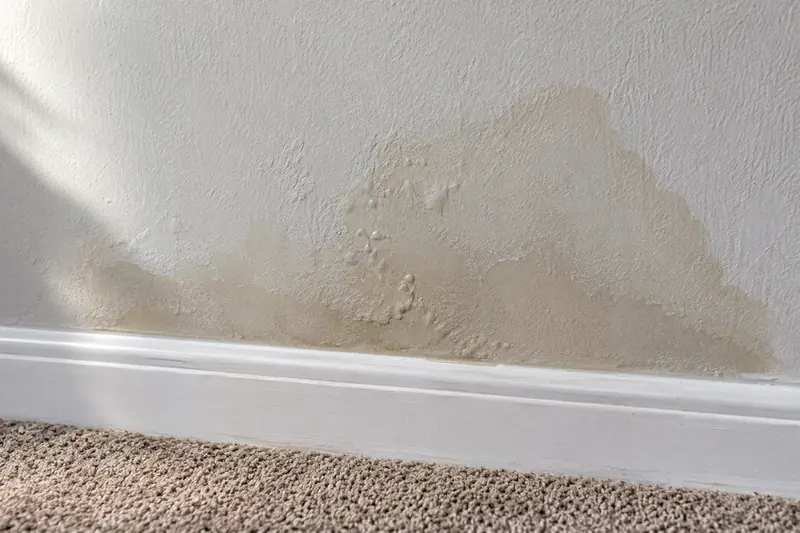
You can't tell from your side. A wet patch on a shared wall could be your supply line, your neighbor's drain, a shared riser, or water that came down inside the wall from a floor above. Water travels along pipes and framing, so the wet spot can sit some way from the leak. Anyone who names the owner before tracing it is guessing.
How does a wet wall get traced?
Report it first, then watch and write down what you see, because staff or a plumber will ask. Timing is often the best clue.
| What you notice | What it can point to | Who can check |
|---|---|---|
| Wet all the time, even when nobody is using water | A supply line under constant pressure | Staff or plumber, with the fixtures off |
| Wet only after a shower, flush or laundry next door or above | A drain line or a fixture seal | Staff, running that unit's fixtures one at a time |
| Wet after rain or on a window wall | Water from outside, not plumbing at all | Association or manager |
| Dark line low on the wall, sewer smell | A drain or stack | Staff and a pro; stop using your drains and see below |
These are clues, not findings. A plumber may want to check both units, which is why you need staff involved: you can't get into the neighbor's bathroom, but they can usually arrange it. If your unit has its own water meter, the meter may help show a leak in that unit, per EPA's notes on metering. Ask whoever is tracing it to check.
Sewer smell changes the job. If that's what you have, go to the page on sewage from a stack instead of poking around. If you hear water running in that wall, this page on running water sounds may help narrow it down.
Who gets to open the wall?
Not you, at least not yet. A shared wall can hold common elements, including risers and stacks, and cutting into it may need association approval. Opening it also destroys evidence your insurer may want to see. Get photos first, then let the party responsible for the trace decide where to cut.
Then there are two costs people tend to confuse: fixing the pipe, and closing and repainting the wall. Some declarations put these in different places. Look for the definition of unit and common elements to see who owns what's inside the wall, then the maintenance article for who repairs it. The general guide to which pipes are yours has more on reading those sections.
Should you wait and see?
No. Tell someone today, even if the spot is the size of a coin. Most policies don't cover gradual leaks, even undetected ones, so a dated report that you noticed it and spoke up matters. EPA also lists the area inside walls around leaking pipes among the places mold can hide, and drying fast only works once the water has stopped.
If you own
Write to the manager and ask who will arrange the trace. If you're told to hire your own plumber first, ask which part of the declaration says so and how the cost gets settled if the line proves to be shared.
If you rent
Send your landlord a photo and the date. Tracing and repair are generally the landlord's to arrange with the building, so don't let your neighbor or the manager draw you into that argument. Keep your things off the wall.
The short of it
A wet wall has no owner until the leak is traced. Report it, write down when it gets worse, and keep everyone's saws away until the source is known.
Asked next
The neighbor says it's your pipe. What's a fair answer?
Say you've reported it and would like the source traced before anyone decides. That's fair to both of you, and neither of you can see inside the wall. Ask staff to put the finding in writing.
Is cutting a small hole just to look okay?
Check first. A small hole can still cut through something shared, disturb evidence, or breach an approval rule. Ask the manager or landlord, and take photos before anything changes.
The wall dried out by itself. Is it over?
Not necessarily. A dry surface might mean an old leak or one that only runs when a certain fixture is in use. Keep the report open and mark the outline with a date, then look again after a few days.
Who pays for the plumber who finds the leak?
It varies. Often whoever called the plumber gets the first invoice, and it gets sorted out when the source is known. Ask before work begins, and keep the invoice and the written finding.
Read it yourself
- Washington Office of the Insurance Commissioner, Leaks, water damage and mold: gradual leaks behind walls, read Nov 3, 2026.
- EPA, A Brief Guide to Mold, Moisture and Your Home: hidden mold inside walls around pipes, read Nov 3, 2026.
- EPA WaterSense, metering tech sheet: individual meters help identify leaks in a unit, read Nov 3, 2026.
- California Civil Code 4775: default repair duties, California only, archived copy of the official page, captured Sept 14, 2026, read Nov 3, 2026.
- Virginia Code 55.1-1955: common element carve-out, Virginia only, read Nov 3, 2026.
- Florida Statutes 718.113: common element maintenance, Florida only, read Nov 3, 2026.
- Florida Statutes 718.111: repairs with no insurable event, Florida only, read Nov 3, 2026.