Sewage came up into my tub. What now?
Who pays, usually: The association or building usually handles a blocked shared stack. Cleanup inside your unit may fall to the owner, landlord or an insurer, depending on the declaration, lease, cause and your policy's sewer backup terms.
Filed under Probably the association's
When sewage is backing up in a tub in an apartment, stop using every drain, keep people and pets away and call the building now, because this is usually a shared line and not your plunger's job.
From the Whose Pipe Is It? desk. Sources last checked November 3, 2026. .
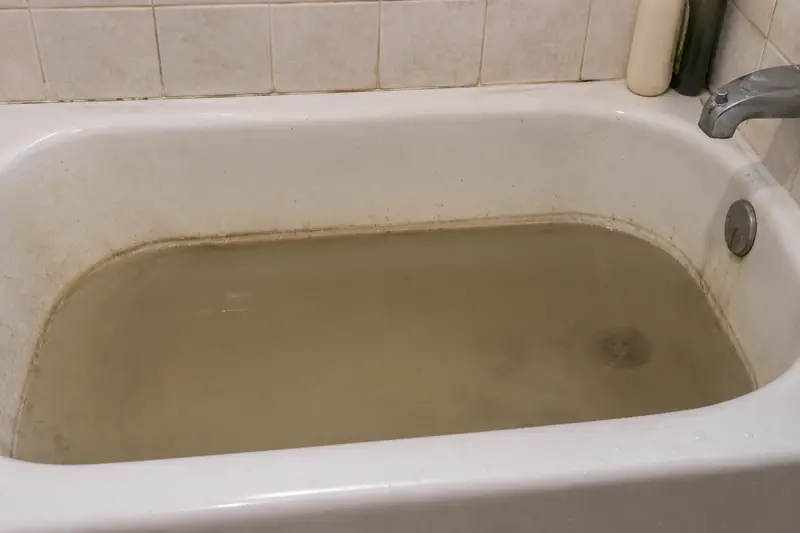
A tub or shower is often the bottom-most opening on a line, so that is where a blockage farther down tends to come up. Other people's water is still arriving from above. You cannot fix that from your bathroom, but the first half hour still matters.
The first half hour, in order
- Stop everything that drains: toilets, sinks, the shower, dishwasher and washer. Tell everyone at home.
- Leave the bathroom and keep the door shut if you can do that without stepping in anything.
- Call the building's emergency line, super or manager. Say sewage is coming up, your unit and floor, when it started and whether it is still rising.
- Ask them to warn the floors above to stop using water on that line. Operating a stack, riser or building valve is not your job.
- Take photos and video from the doorway, with the time noted.
- Call your insurer or agent the same day, before anything is thrown away or repaired beyond what safety requires.
In New York City only, the water department says to report raw sewage backing up into your home to 311 at once, and the city's cleanup page points tenants to the indoor sewage leak or odor complaint. Elsewhere, ask your city's sewer or health department whether it takes these reports.
Who should clean it, and how?
Do not start until staff say the line is clear, or you will be cleaning it twice. For anything beyond a small spill, a professional is the sensible choice, and it may be the building's or your insurer's to arrange.
| Item | What they say |
|---|---|
| Protection | Washington's health department says rubber gloves, boots and eye protection |
| Hard surfaces | Hot water and mild detergent, then a rinse of one tablespoon of unscented household bleach per gallon of water |
| Soaked wall-to-wall carpet and pad | Usually cannot be adequately cleaned, says Washington |
| Soft goods that cannot be cleaned and dried | New York City says discard them |
| Food that touched sewage water | Discard it, including packaged food |
| Soaked drywall and insulation | CDC says remove and discard them |
Local ratios differ, and New York City's bleach mix is stronger than Washington's, so use your own health department's if it publishes one. Use bleach by itself rather than with other cleaners. Wash up and launder your clothes separately afterward. Then get things dry, because EPA's window is 24-48 hours to prevent mold growth. Drying out after a leak goes through that part. Do not run electrical equipment near standing water, as New York City warns.
Who pays for all of this?
Three bills hide in one event: clearing the line, cleaning your unit and replacing your things. A shared stack is usually a common element, so the first is often the building's. The other two depend on your documents, your policies and what can be shown about the cause.
NAIC names sewer backup among the things home policies may need added. New York's insurance regulator describes a water backup endorsement, offered by some insurers at extra cost and up to a chosen limit. Backup cover for renters and flood versus backup go further.
If you own
Report it to the association in writing the same day, and ask what its contractor found and where. Check your HO-6 for a sewer or water backup endorsement before you agree to anything. Read your declaration's maintenance article and insurance article together, because they may split the line and the interior differently.
If you rent
The landlord is your contact for the line and the unit, and California's Civil Code 1941.1, for California only, lists a working sewage connection among rental conditions. The landlord's policy does not cover your belongings, so call your renters insurer about those. If the unit is not livable, ask about loss of use under your policy, and what your lease says.
The short of it
Stop the water, keep clear, and get the building on the phone. Clean only after the line is cleared, and photograph everything before it goes in the trash.
Asked next
Is it safe to stay in the apartment during a sewage backup?
That depends on how much there is and where. Keep everyone out of the affected rooms, and leave if it is spreading, you feel unwell or it is near power. New York City advises seeking medical attention if you are injured or become ill.
Can you use the toilet if only the tub backed up?
No. It connects to the same system, and a flush can send more into the tub or to a neighbor's fixture. Wait until staff tell you the line is clear, and use a restroom away from that line until then, since a neighbor's toilet may feed the same stack.
Can you be blamed for a stack backup?
A shared stack has many users, so ask what was found, where and by whom. Money at stake is a reason to talk to a lawyer licensed in your state.
Read it yourself
- Washington State Department of Health, sewage spills: protection, surfaces, bleach mix, carpet and keeping children and pets out, read Nov 3, 2026.
- NYC311, sewage or flood clean-up: what to discard, electrical warning, medical attention and the tenant complaint, read Nov 3, 2026.
- NYC Environmental Protection, sewer backups: report to 311, read Nov 3, 2026.
- CDC, natural disaster safety: drywall and insulation, read Nov 3, 2026.
- EPA, brief guide to mold and moisture: 24-48 hours, read Nov 3, 2026.
- Code of Virginia 55.1-1955: condition originating in the common elements, read Nov 3, 2026.
- California Civil Code 1941.1: sewage connection, archived copy of the official page, captured Sep 14, 2026, read Nov 3, 2026.
- NAIC, what home insurance does not cover: sewer backup as an addition, archived copy of the official page, captured Jun 16, 2026, read Nov 3, 2026.
- New York DFS, homeowners and tenants guide: water backup endorsement, read Nov 3, 2026.
- California Department of Insurance, residential guide: the landlord's policy and a renter's belongings, read Nov 3, 2026.