My kitchen sink keeps backing up. Is it my drain or the building's?
Who pays, usually: A clog in your own trap or branch often falls to the unit owner, or the landlord for renters. A blockage in a shared line is usually the building's, unless your documents say otherwise.
Filed under Not clear yet
A kitchen sink backing up in an apartment is usually your own branch if only your sink is affected, and more likely the shared line if it fills when neighbors run water.
From the Whose Pipe Is It? desk. Sources last checked November 3, 2026. .
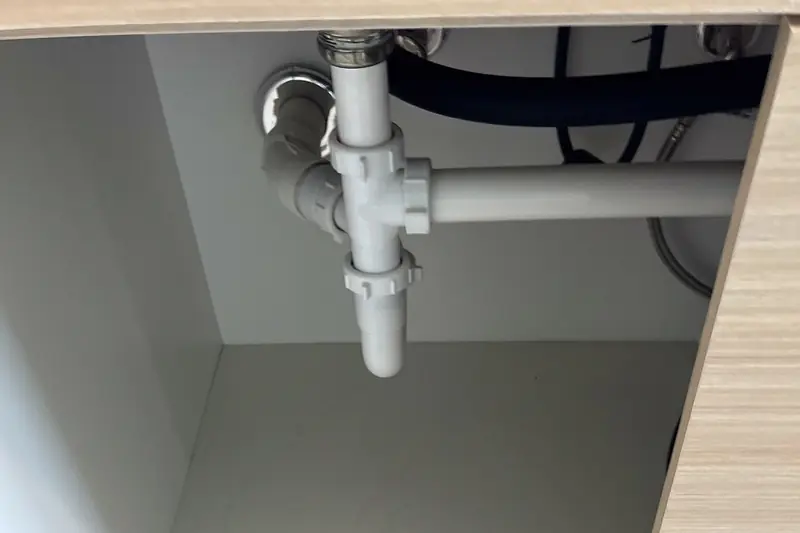
The most useful question is not what caused it. It is whether the water rises when nobody in your home has touched a faucet. Your own clog only misbehaves when you use your own sink. A shared line blockage can fill your sink while you are standing there with the water off.
How do you tell which line it is?
| Try this | If you see this | It points to |
|---|---|---|
| Run a little water in the bathroom sink | It drains normally | Your kitchen branch, not the whole home |
| Run the dishwasher or the other kitchen basin | Dirty water rises in the sink | Your branch, or the trap below it |
| Watch the sink at breakfast and dinner, with your taps off | The level rises or gurgles | The shared line |
| Ask the neighbors above and below | They have slow drains too | The shared line, and staff should hear today |
Kitchens in a building are often stacked one above another, so one vertical line can collect from every kitchen in the column. A blockage low on that line backs up into the bottom kitchens first, with the upper floors none the wiser. That is why the people who complain may not be the people whose habits caused it. For more on how the column works, see risers and stacks in plain words.
What about the grease?
Grease is the usual suspect, and for good reason. Seattle Public Utilities says it hardens and sticks to pipes, building up over time. New York City's water department names grease, wipes and other items in toilets and sinks as the top cause of sewer backups in the city. Both are talking about pipes in general rather than apartment lines in particular, but a column of kitchens is a fair place to expect the same thing.
The habit that helps is simple: let grease cool, put it in a sealed container and throw it away. Hot water and dish soap do not make it disappear. They move it along to a colder stretch of pipe, where it may be somebody else's problem.
If it really is only your sink, what can you do?
A plunger on your own dishwater is reasonable, with the other basin stopped. Run no more water until it clears. Skip the drain chemicals: they rarely reach a deep clog, and they sit in the trap waiting for whoever opens it next. A plumber can clear the trap and the branch.
Before the plumber leaves, ask for two things in writing: where the blockage was, and how far in from your sink. That single detail is often what decides who pays, because it says which side of the shared line the trouble sat on. If it recurs, the record of dates matters too, and which pipes are likely yours will help you read it.
If you own
Look at how your declaration describes pipes serving only one unit, then ask the manager whether the association snakes branch lines or leaves them to owners. Call staff before hiring anyone if neighbors are affected, since they may have a contractor and a required procedure. Keep the plumber's note if it found the blockage in a shared section, and ask about reimbursement.
If you rent
Report it and let the landlord arrange the repair, unless your lease says otherwise. Mention whether you checked with neighbors, and when the sink backs up. If the landlord says you caused the clog, ask for what the plumber found, because the fix may have had little to do with your kitchen.
The short of it
A sink that only backs up when you use it is probably yours. A sink that fills on its own belongs to the building until proven otherwise, and at that point the job is to stop using it and call.
Asked next
Can a garbage disposal cause a shared line to back up?
It sends food down the pipe, and whatever does not keep moving can add to a buildup. Rules on disposals vary by building, so check your rules. Fats and fibrous scraps belong in the trash either way.
Can the building make you pay for clearing a shared kitchen line?
That depends on your documents, your state and what a plumber can show about the cause. A shared line with many users makes it hard to pin on one household. If you receive a bill, ask what evidence supports it and ask a lawyer if the amount justifies it.
How often should a shared kitchen line be cleaned?
We found no official interval. Buildings with repeat trouble often put certain lines on a regular cleaning schedule. If your stack backs up more than once, asking the board or landlord for that is reasonable.
Should you keep using the sink once it drains again?
Yes, if it was your own clog and it now drains freely. If it was a shared backup, wait until staff say the line has been cleared, because the blockage may only have shifted. A drain that clears by itself has not necessarily been fixed.
Read it yourself
- Seattle Public Utilities, fats, oils and grease: how grease builds up, and cooling it before disposal, read Nov 3, 2026.
- NYC Environmental Protection, sewer backups: the most common cause in the city, and grease disposal, read Nov 3, 2026.