Why does my apartment smell like a sewer?
Who pays, usually: Refilling a dry trap costs only a little water. A broken trap or toilet seal in your unit often falls to the owner or landlord, while a blocked vent or cracked stack usually goes to the building.
Filed under Not clear yet
An apartment that smells like a sewer often has a dry trap, so unless it could be gas, run water in those drains. If the smell lingers, a seal, vent or stack may be involved and tell the building.
From the Whose Pipe Is It? desk. Sources last checked November 3, 2026. .
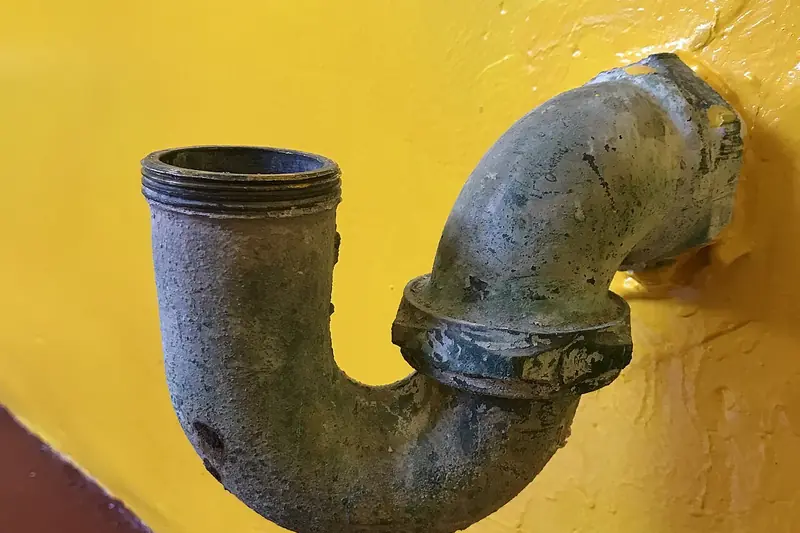
Under every sink, tub and floor drain is a bend that holds water. That water is the only thing between your home and the drain system. Code text such as North Carolina's adoption calls for a seal of 2 to 4 inches, and it recognizes that those seals can evaporate. A guest bath you never use can go dry on its own, and then the air from the pipe simply walks in.
Wisconsin's health department suggests following a sewer odor to its point of entry and running water in floor and sink drains. Once you are sure it isn't gas, start there, room by room.
| Where | What to do | If that does not settle it |
|---|---|---|
| A sink or tub you rarely use | Run water for a minute or so | Try again tomorrow, then move on |
| A floor drain in a laundry or utility space | Pour in water | Tell staff, since it may need a closer look |
| The washer standpipe | Check that the hose is in and nothing is wet | A plumber or the landlord |
| Under the kitchen and bathroom sinks | Look for a loose, dripping or disconnected trap | A plumber or the landlord |
| The base of each toilet | Check for rocking or dampness, which can mean a failed seal | A plumber or the landlord, soon |
| The hallway, a shaft or the whole floor | If it could be gas, leave and call from outside; otherwise don't investigate | Staff, today |
What if the traps are full and it still smells?
Then air is getting in another way, or something is pulling your traps dry. Plumbing vents let air in and out so that water moving through the pipes does not disturb those seals. Wisconsin names a leaking or blocked roof vent as one route for sewer gas. A blocked vent often comes with a sound, so look at why a drain gurgles. Wisconsin's page is written with houses in mind and suggests checking the roof vent. In a shared building, the roof and vent are staff's, not yours.
A leak behind a wall is the other possibility, and Wisconsin says plainly you may need a plumber to find that. Finding the wet spot matters here, since a damp wall between units raises its own questions.
When is it more than a smell?
If the smell comes with slow drains, or anything rising in a fixture, it may be a blockage and not just air. Stop using the drains and go to the sewage backup steps. Smell alone at the same hours each day is also useful to report, because it can follow a neighbor's use of a shared line.
If you own
A trap or toilet seal serving only your unit is often yours to repair, but your declaration's definition of the unit decides that, so check which pipes are yours. Report anything that goes beyond your fixtures to the association in writing, with dates and the rooms affected.
If you rent
Run the water, because that much is simple and yours to try. After that, tell the landlord in writing where the smell is strongest and when it occurs. If you travel, run the drains when you get back and tell the landlord if the smell returned while you were out.
The short of it
Anything that could be gas means leaving first. Otherwise run water into every drain, because a dry trap is common and costs next to nothing to cure. If the smell survives that, it belongs with a plumber or the building.
Asked next
How often should you run water in an unused drain?
Nothing official that could be found sets a schedule. Regular use prevents the problem, so make a guest bath part of your routine, and run each drain after any long absence. If a trap dries out unusually fast, tell your landlord or plumber.
Why does the smell come and go?
Traps can be pulled or pushed by pressure changes when neighbors run water, and vents behave differently with wind and weather. Keep a note of the times, because a pattern is useful to whoever investigates. A smell that follows a neighbor's laundry suggests a shared line.
Is an air freshener or plug-in a reasonable fix?
It hides the warning without fixing anything. Sewer gas can include hydrogen sulfide and ammonia, according to Wisconsin's health department, so treat a stubborn smell as something to find. Get the source looked at.
Read it yourself
- Wisconsin Department of Health Services, sewer gas: routes in, traps, symptoms, evacuation advice, read Nov 3, 2026.
- International Plumbing Code 2021 as adopted by North Carolina, chapter 10: trap seal depth and evaporation, code text as displayed by a third-party code site, read Nov 3, 2026.
- International Plumbing Code 2021 as adopted by North Carolina, chapter 9: vent piping, code text as displayed by a third-party code site, read Nov 3, 2026.