Why are soap suds coming up in my sink?
Who pays, usually: A shared drain stack is usually the association's or building's to deal with, so repeat foaming normally goes to them. You might pay if your own line is the cause or your documents say so.
Filed under Probably the association's
Soap suds coming up in a sink in an apartment usually start with detergent from upstairs, because foam travels down the stack, piles up near the bottom and pushes out through lower-floor fixtures.
From the Whose Pipe Is It? desk. Sources last checked November 3, 2026. .
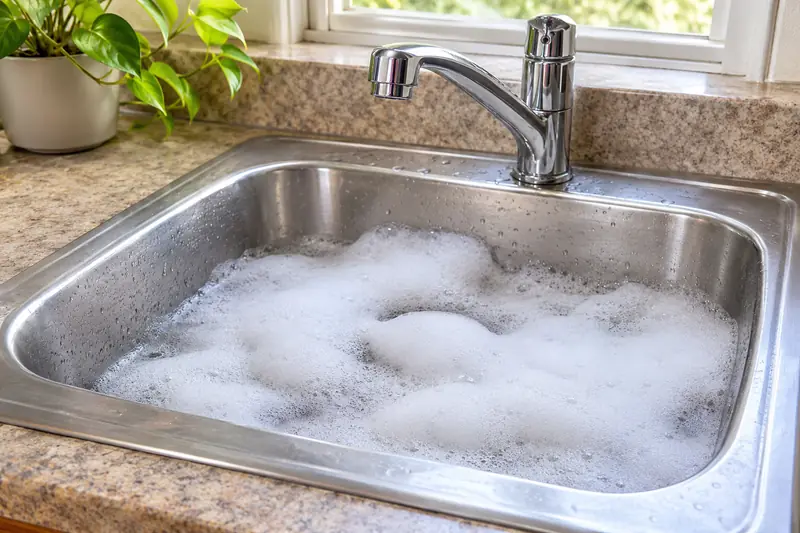
Foam is lighter than water and it does not drain the way water does. Laundry and dish water fall down a shared stack, churn on the way, and arrive at the bend near the bottom as a thick mass of bubbles. That mass blocks the air the pipe needs, and it has to go somewhere. Your sink, on a low floor, is a convenient way out.
This is well enough known that some plumbing codes have a word for it. New York City's plumbing code names suds zones where detergents are used on an upper floor, and it places one within 40 stack diameters of the base fitting. On a 4-inch stack, that is about 13 feet by simple arithmetic, which is why the bottom floors tend to get this and the tenth does not. Other places differ. North Carolina's adoption of the International Plumbing Code, for one, does not use the word in its drainage or vent chapters, so ask your building department what applies. An older building may also have been piped long before any such rule.
Is it really just soap?
Clean white foam that fades away is one thing. If it is gray or brown, or if it smells, or if water follows it, treat it as a backup. Stop using your drains and go straight to the page on a sewage backup.
What should you do when it happens?
- Stop running water in your own home for the moment. You are adding to the same line.
- Note the time, the fixture and how far the foam rose. A photo helps.
- Skip the plunger and do not pour in anything to knock the foam down.
- Report it to staff or the manager, and ask whether others on your line have seen it.
The timing is what makes the report useful. Foam at the same hours, or on one day a week, tells a plumber a lot about where the laundry load is coming from. If your drains also gurgle when neighbors run water, mention that too, because the same air problem can cause both.
Whose laundry is it, and does that matter?
Try not to turn this into a dispute with an upstairs neighbor. Doing a normal load of laundry is not misconduct, and the actual weakness may be a narrow or poorly vented section of pipe. A gentle building-wide reminder about using the right amount of detergent can help, and a pipe correction by a licensed plumber is the lasting answer. New washer hookups in a building are worth a board's attention for the same reason.
If you own
Ask the association to have a plumber look at the base of the stack, since that section is very likely a common element. Reference your dates and times. If you are on the bottom floor, ask the board in writing whether a venting or piping change is possible, so the request is on record.
If you rent
Report each episode to the landlord with the date and a photo. It is not yours to fix, and you should not be charged for foam from a shared stack without an explanation. Ask to be told what the plumber finds.
The short of it
Suds in a low-floor sink usually mean a shared stack problem that started on someone else's floor. Report it with times, keep it civil and leave the pipe work to the building.
Asked next
Why do suds show up in the tub instead of the sink?
Foam takes the easiest way out, which is often the fixture farthest down the line. In some homes that is the tub or shower, and in others the kitchen sink. The same explanation applies wherever it appears.
Does high-efficiency detergent stop this?
Using the amount the label calls for may reduce the foam, and too much soap makes things worse. We found nothing that measures it in apartment stacks, so treat it as a sensible habit and not a cure. A building with a persistent problem needs a pipe answer.
Is foam from a drain harmful?
Clean soap foam is mostly a mess. Anything discolored or smelly should be treated as wastewater, so keep clear, keep children and pets away and call the building. Wash your hands after any contact.
Read it yourself
- NYC Plumbing Code 2022, chapter 7: section 704.6 on suds zones and 40 stack diameters, code text as displayed by a third-party code site, read Nov 3, 2026.
- International Plumbing Code 2021 as adopted by North Carolina, chapter 9: no suds wording in that adoption's vent chapter, code text as displayed by a third-party code site, read Nov 3, 2026.
- International Plumbing Code 2021 as adopted by North Carolina, chapter 7: no suds wording in that adoption's drainage chapter, code text as displayed by a third-party code site, read Nov 3, 2026.