Can I add a washing machine to my apartment?
Who pays, usually: You usually pay for the machine and any plumbing to install it; the lease or association rules decide whether it's allowed at all, and a leak from it may land on you.
Filed under Probably yours
A washing machine in an apartment works only when the rules allow it and the unit has a proper drain, water valves, venting and power, so check permission first and buy the machine last.
From the Whose Pipe Is It? desk. Sources last checked November 3, 2026. .
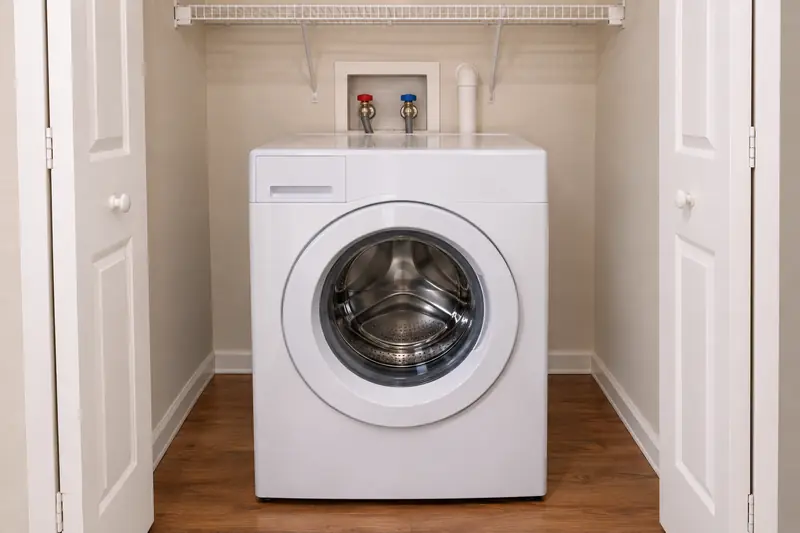
Check in that order. A machine sitting in its box is an expensive way to learn that your lease says no, and plenty of leases and house rules do say no.
Buildings have fair reasons. A failed hose sends water through a ceiling, and suds can cause trouble in shared drains. So the first question is a paperwork question, and the next three are about the wall behind the machine.
Four questions, before you buy
- Is it allowed? Look in the lease if you rent, or the rules and alterations article if you own. Then ask the manager, in writing, about a machine on your floor.
- Is there a drain that can take it? A washer pumps out a lot of water quickly. Look for a standpipe, then have a plumber confirm that it's vented and sized for the job.
- Is there hot and cold water with valves you can reach? You'll want them where you can close them after each load or before a trip.
- Is there suitable power? Check the manual for what the machine needs. Anything beyond plugging into a suitable outlet is an electrician's work.
What makes a washer drain acceptable?
Height is part of it. Samsung's manual recommends a standpipe 39 inches high, and that's about right for current models, though yours may differ, so check the manual. A hose hung into a sink is a different arrangement and needs its own permission and thought, because a blocked sink then overflows onto your floor.
The bigger question is what the standpipe connects to. An old kitchen or bath line in a tall building may not have been meant to take a washer's discharge, and some local codes pay particular attention to places where suds collect low in a stack. New York City's code does this by name, placing suds zones within 40 stack diameters of the base fitting. That rule is New York City's. If you live low in a building, read about suds coming up in a sink before assuming a drain will cope.
What should a plumber look at on the supply side?
Two things that are easy to skip. The code text displayed for North Carolina requires a water-hammer arrestor where quick-closing valves are used for clothes washers. Without one, you and your neighbors may hear banging pipes every time the machine fills.
A report funded by the US Department of Energy also names washing machine connections as one place hot and cold water can cross over in a shared hot water system. It's a reason to get the hookup done properly, with a plumber who knows the building has a central system, if it does.
What's the plan for a leak?
Assume one will happen and decide now how small it will be. Samsung wants the taps closed whenever the washer isn't in use. LG adds unplugging it before an extended absence. In a shared building, those are especially good instructions.
Add to that a few cheap habits. Stay home while it runs. Know where the nearest shutoff valve for the unit is. Put a leak sensor on the floor behind the machine. Note the hose date and replace the hoses on time.
Then ask your agent how a washer changes your own cover. If your machine floods the unit below, the answer to who pays won't be simple.
If you own
Read the rules on appliances and the alterations article together. Some associations allow washers with a pan, specific hoses or a plumber's sign-off, and some bar them outright or only on some lines. Expect to pay for the plumbing, and keep the approval with your unit's papers.
If you rent
You need the landlord's written yes, and in a rented condo the association's rules may apply as well. Spell out who owns the machine, who services it and who answers for a leak. Put it in writing either way.
The short of it
Ask first, check the drain second, shop third. A washer can work in an apartment, but only with permission, a vented drain, valves you can reach and the habit of closing them.
Asked next
Is a washer on a high floor worse than one on a low floor?
Each has its own risk. A leak on a high floor can reach more people below, and a drain low in the building may see suds and backups from above. Your manager or a local plumber can tell you how your stack behaves.
Does a portable washer that hooks to the faucet avoid the rules?
Not necessarily. It needs no plumbing work, but the lease or rules may still count it as a washer. Its hose and the sink drain are the weak points, so never leave it running.
Will the building require a pan?
Some do, so look in the rules or ask the manager. A plumber can tell you whether a pan can be piped to a drain in your space.
Read it yourself
- Samsung washer manual: standpipe height and turning off the taps, read Nov 3, 2026.
- LG washer owner's manual: turning off faucets and unplugging for an extended period, read Nov 3, 2026.
- IPC 2021 as adopted by North Carolina, chapter 6, section 604.9: water-hammer arrestors for clothes washers, code text as displayed by a third-party code site, read Nov 3, 2026.
- NYC Plumbing Code 2022, chapter 7, section 704.6: suds zones in New York City, code text as displayed by a third-party code site, read Nov 3, 2026.
- DOE-funded report on central domestic hot water systems: crossover at washing machine connections, read Nov 3, 2026.