Are leak sensors worth it in a condo or apartment?
Who pays, usually: You usually buy your own sensors; a shutoff valve cut into a pipe is different, usually needing approval from the association or landlord and a plumber, normally at the expense of whoever asked for it.
Filed under Probably yours
Water leak sensors in an apartment are usually worth it for the slow, hidden drip, as long as someone will actually hear the alarm or get the alert in time to act.
From the Whose Pipe Is It? desk. Sources last checked November 3, 2026. .
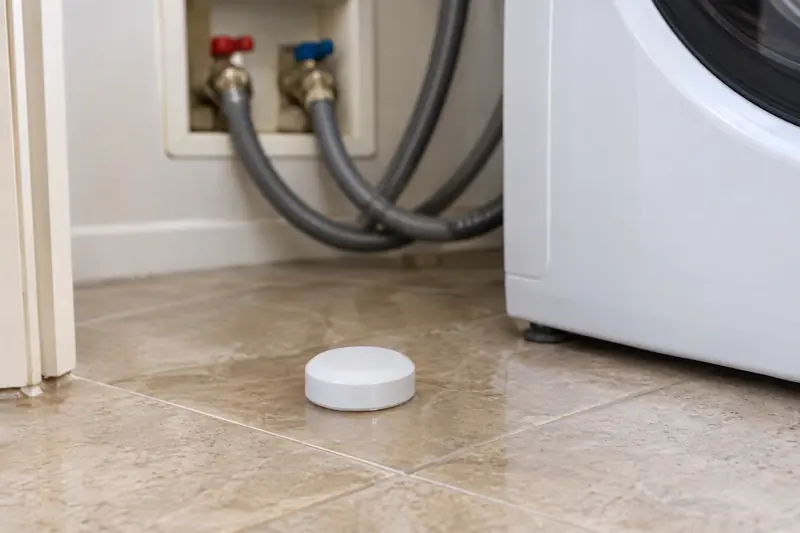
That condition is the whole question. A sensor that shrieks in an empty apartment during your week away has told nobody anything. A sensor that sends a message to your phone, and a neighbor with a key, is a different product.
They earn their place for one plain reason: the leaks that do the most quiet damage happen where you never look. A sensor can't stop water. It shortens the time between the start of a leak and someone knowing.
Why does that time matter so much?
Two reasons, and neither is about the gadget. The EPA says to dry water-damaged areas and items within 24-48 hours to prevent mold growth, and you can't start drying what you don't know about. Insurance is the other: Washington's and Texas's regulators both say most policies don't cover gradual leaks, and Washington adds that this holds even when the leak went undetected. Check how yours reads, and see how an HO-6 treats water damage. The slow drip behind a toilet is exactly the kind of thing a sensor can catch early.
| Spot | What it's watching | Where to set it |
|---|---|---|
| Behind the washer | Hoses, valves, the drain hookup | On the floor at the low point, clear of the drum's shake |
| Water heater closet | Tank, connections, pan | Beside the tank or pan, away from any burner or flue |
| Under the kitchen sink | Stops, supply lines, filter, disposer | At the back of the cabinet floor |
| Behind the toilet | Supply line, tank seal | On the floor near the base, where it won't get mopped |
| Under the dishwasher or fridge line | Connections you can't see | As near as you can reach, on the floor |
What should you look for when buying one?
A loud local alarm and, if you can use it, an alert to a phone. Share that alert with someone nearby who has a key and knows who to call. Check the batteries on a schedule, and test each one as the instructions allow.
Sensors do not replace knowing where your own shutoff is. When an alarm sounds, close that valve if you know it, then get staff or the emergency line on the phone, and keep clear of any water near outlets.
And the valves that shut off automatically?
EPA describes leak devices as working by moisture detection or by flow monitoring. An automatic shutoff goes a step further and closes a valve on the line when it decides something's wrong. That's a real change to the plumbing, and it brings four questions a stick-on sensor doesn't:
- Is there one place to fit it? Many apartments are fed from more than one riser, so a single valve may not protect everything.
- Whose pipe is it? Find out with your declaration's definitions before anyone cuts in.
- Who approves it? Expect the association or landlord to want a say, and a licensed plumber to do it.
- Could it shut off something it shouldn't? Ask before fitting it on any line shared with a neighbor. It should never go on a riser.
No neutral figures were found on how much damage these devices prevent, so treat any advertised number with care.
If you own
Stick-on sensors rarely need anyone's approval. For a motorized valve, ask the manager first, get the plumber's scope in writing, and ask your agent whether the device changes anything on your policy. Don't assume a discount.
If you rent
Battery sensors are ideal for you, since they involve no plumbing and leave with you when you go. Don't let anyone fit a valve without the landlord's written yes. If a sensor goes off, tell the landlord in writing as well as by phone, and keep a note of when.
The short of it
Buy them for the washer, the water heater and under the sinks, and make sure the alert reaches someone who can act. Treat automatic valves as a plumbing project with a permission slip, not as a gadget.
Asked next
Do sensors work during a power or internet outage?
A battery sensor's local alarm usually keeps working, but a phone alert may not get through. Check the manual, and choose battery backup if you travel.
Can a sensor detect a leak inside the wall?
Not directly. A floor sensor only reacts when water reaches it, so a pipe leaking in the wall may show up as a stain first. Flow monitors can sometimes notice water running when nothing's in use, if they can be fitted to your line at all.
Should the association put sensors in every unit?
Ask the board whether it has come up. It raises questions of cost, access and who responds. Your own sensors don't need to wait for that.
Read it yourself
- EPA WaterSense, leak detection and flow monitoring devices: moisture detection and flow monitoring, read Nov 3, 2026.
- EPA, a brief guide to mold, moisture and your home: drying within 24-48 hours, read Nov 3, 2026.
- Washington Office of the Insurance Commissioner, leaks, water damage and mold: gradual leaks and most policies, read Nov 3, 2026.
- Texas Department of Insurance, water damage and mold: gradual leaks in homeowner and renters policies, read Nov 3, 2026.