Can I put a water softener or filter in my apartment?
Who pays, usually: You normally pay for treatment equipment you want for your own unit; the association or landlord usually decides anything plumbed in, and some declarations leave its upkeep and insurance with the owner.
Filed under Probably yours
A water softener for an apartment is possible only with a drain, space, power and usually the building's approval, while a filter is far simpler, and some filters need no plumbing at all.
From the Whose Pipe Is It? desk. Sources last checked November 3, 2026. .
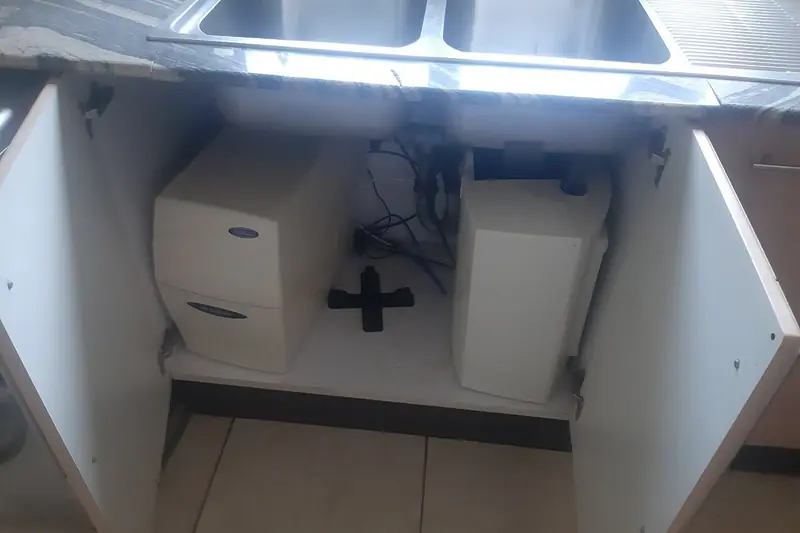
Start by asking what's bothering you. Spots, scale and stiff laundry point to hardness, which a softener addresses. Taste, chlorine or a worry about lead are filter questions. They're different machines, and the smaller one may be all you need.
If you want a number, USGS classes water as soft up to 60 mg/L as calcium carbonate, moderately hard from 61 to 120, hard from 121 to 180 and very hard above that. Your water utility's report or a home test kit will place you. If your concern is lead, the EPA points to filters tested against NSF/ANSI Standard 53 that also claim lead reduction. A softener isn't sold for that job.
| Option | What it needs | Who usually needs to agree |
|---|---|---|
| Pitcher or countertop filter | Nothing but counter or fridge space | Nobody |
| Faucet-mounted filter | A faucet thread it fits | Usually nobody; keep the old aerator for move-out |
| Under-sink filter | A connection at the stop, cabinet space | The landlord if you rent; a look at the rules if you own |
| Under-sink reverse osmosis | The above, plus a waste line to the drain | The same, and worth a plumber |
| Softener or whole-unit filter | A cut into the unit's line, a drain, power, floor space, salt | Association or landlord, and a licensed plumber |
The EPA's home water treatment guide sums up the split: point-of-use devices are "best suited" to water for drinking and cooking, and a whole-house system treats water where it enters the building. That's where apartments run into trouble, because yours doesn't have that point.
Why is a softener such a hard fit?
There may be no single place to put it. Many units are fed from more than one riser, so a kitchen and a bathroom can be on separate lines, with no one pipe serving them all. It also has to discharge somewhere: softeners flush brine to a drain, and a line shared with the floors below is something a board will ask about. Then there's the leak risk, with a tank and valves above someone's ceiling, and the salt you have to carry and store.
And it may be restricted where you live. The EPA notes that some local jurisdictions restrict these systems. California law allows a local agency to act against self-regenerating softeners after a regional water board finding, which is a local matter, not a statewide ban. Ask your water utility or building department before you buy.
If you go ahead, the EPA suggests looking for a softener certified to NSF/ANSI 44. Its voluntary efficiency rating is 5.0 gallons of water or fewer per 1,000 grains of hardness removed.
What should you ask before anyone cuts a pipe?
Put these to the manager or landlord in writing:
- Are softeners or plumbed filters allowed, and is there a form for them?
- Which pipes may be tapped, and who decides? Finding out whose pipes they are comes first.
- Where may the waste go, and is a licensed plumber or permit required?
- Who pays if it leaks, and does the equipment have to come out when you sell or move?
Whoever does it should put a shutoff on the new equipment, so you can isolate it yourself. If your complaint is one weak faucet, clean the aerator before buying anything, and if it's older pipes and lead, read that first.
If you own
Read the alterations article and the rules, and get the board's yes in writing for anything plumbed in. Tell your insurance agent. Keep the manual and the plumber's invoice with your unit's papers.
If you rent
A pitcher or countertop filter is your friend. It needs no permission and moves with you. Anything fastened to the plumbing needs the landlord's written approval, including who owns it at move-out and who answers for a leak.
The short of it
For taste and drinking water, a filter at the tap is the easier fit in most apartments. Softening is a separate job: a softener can work, but it needs a drain, a place on the line, and someone's written approval.
Asked next
Are there softeners that need no plumbing?
Some products attach to a single fixture, like a showerhead or faucet. They're much smaller in scope than a full softener, so check exactly what they claim and whether they're certified. If you rent, keep the original parts to put back when you leave.
Will a softener or filter change my water pressure?
It can, a little, and a clogged cartridge can slow things noticeably. Ask your plumber what drop to expect from a given model.
Does a reverse osmosis filter waste water?
It sends some water to the drain as part of how it works, and the amount varies by model. Check the maker's figures before you choose.
Read it yourself
- USGS, hardness of water: hardness classes, read Nov 3, 2026.
- EPA WaterSense home water treatment guide: point-of-use and whole-house systems, local restrictions, NSF/ANSI 44, read Nov 3, 2026.
- EPA, how to identify filters certified to reduce lead: NSF/ANSI Standard 53 with a lead reduction claim, read Nov 3, 2026.
- California Central Coast Water Board resolution: local control of self-regenerating softeners under Water Code 13148, as described in the resolution; the code section itself was not read. Read Nov 3, 2026.
- Florida Statutes 718.111: water filters outside the master policy, read Nov 3, 2026.