My water heater is in a closet. What should I watch for?
Who pays, usually: Owners often pay for a heater serving only their unit, depending on the declaration; if you rent, the landlord usually repairs or replaces it, and any leak below may involve several insurers.
Filed under Probably yours
With a water heater in a closet in your apartment, watch for damp at the base, its age, clutter around it and water hotter than 120 degrees, and leave all servicing to a licensed pro.
From the Whose Pipe Is It? desk. Sources last checked November 3, 2026. .
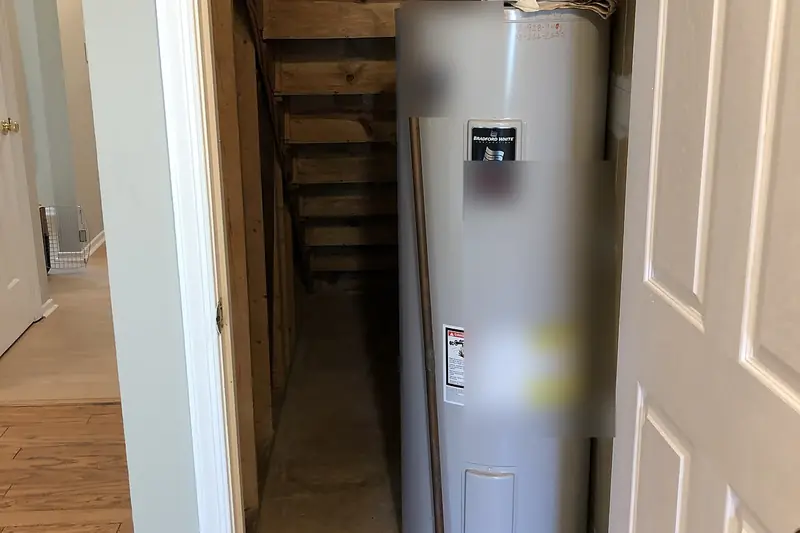
This is a looking job, not a tinkering job. Maintenance, burners, gas parts, relighting and venting are all work for a licensed pro, and hotwater.com's own manual tells anyone not qualified and licensed not to attempt them. You can do a lot of good with a flashlight and a few minutes.
What do you look at, and how often?
Every so often, open the door and look. You're after these:
- Water or rust on the floor, on the tank's base, or in the pan.
- Rust or crust on the pipes at the top.
- A drip from the pipe coming off the relief valve. That valve is a safety device, so never cap or plug it. Tell the landlord or a plumber.
- A gas smell, or a carbon monoxide alarm, dizziness or headache near a gas unit. Don't investigate. Get out of the building before anything else; no switches or phones until you're out, and the call to 911 or the gas utility happens from outside. CPSC's advice if you suspect CO poisoning is to get outside to fresh air immediately and then call 911.
- Soot or scorching on a gas unit. Stop using it if you can do that without touching the gas parts, and have a licensed pro look at it today.
- Boxes, laundry or cleaning products that have crept too close.
If water is moving, use your unit's shutoff if you know it, then reach staff or the emergency line. Keep out of water around anything electric. Touch a breaker only from somewhere dry; if you can't, leave it for staff. A leak sensor by the tank is worth having because closets stay closed.
Why does the pan matter so much here?
Your closet's floor is somebody's ceiling. Maker manuals call for a pan piped to a drain where a leak could reach floors below, and hotwater.com's residential gas manual says an upper floor isn't advisable at all. Plenty of apartments have one anyway, so check yours: is there a pan, and does a pipe run from it to an actual drain? A pan with no drain only delays things. Let the plumber specify the size.
How old is it?
The Department of Energy gives 10 to 15 years for most storage models. The label usually carries a serial number that encodes the date, and the maker can decode it. Past that range, start planning. A planned replacement can be scheduled, approved and permitted, and a burst tank can't. Ask the board first what it requires.
How hot is too hot?
The CPSC and the Department of Energy both point to 120 degrees. DOE calls it a temperature considered safe for most of the population, and that "most" is worth keeping in mind for small children and older adults. CPSC gives these times for third-degree burns in most adults: two seconds at 150 degrees, six at 140, thirty at 130 and five minutes at 120.
- 150 degrees2 seconds
- 140 degrees6 seconds
- 130 degrees30 seconds
- 120 degrees5 minutes
If the tap seems hotter than that, ask your landlord or a licensed pro to check the heater. Setting it is part of their job. If it's a shared building system, tell staff.
What can't be kept in there?
Rheem's manual says not to store or use gasoline or other flammable vapors or liquids nearby. Paint, thinners, aerosols and solvents go elsewhere. Clearances vary by model, and a closet packed with coats is a problem for the next plumber too.
A gas unit also needs air to burn. hotwater.com's manual says not to install one in a confined area such as a closet unless air is provided. So never block louvers or seal gaps at the door. Venting concerns go to a licensed pro, right away.
Does hard water matter?
A bit, in the slow way. Hard water leaves scale in tanks and fixtures. USGS classes more than 180 mg/L as very hard. Flushing a tank is maintenance, so hand that to a pro.
If you own
Look up the heater in your declaration's maintenance article, and see whether the rules set a replacement age or require a pan. Keep the installation date. Ask your agent how the policy treats a leak reaching the unit below.
If you rent
It's usually the landlord's equipment. Report damp, rust, a dripping relief pipe or scalding water in writing, and don't try to fix it. If you have no hot water and no answer, your lease and state law decide what comes next.
The short of it
Look regularly, know its age, keep the closet clear, and ask for the water to be set near 120 degrees. Anything that involves gas, venting, wiring or taking the tank apart belongs to a licensed pro.
Asked next
Should the closet door be kept open?
Follow what your manual and building say; a louvered door is usually there to supply air, so don't swap it for a solid one. If you see soot on a gas unit, get a licensed pro in promptly.
The pilot went out. Should you relight it?
Leave it for a licensed pro or your landlord. If you smell any gas at all, leave the building first and call from outside.
Who pays when a closet heater leaks through the ceiling?
That depends on where the failure started, your documents, the state and the policies involved. Call your own insurer first.
Read it yourself
- Rheem water heater manual: drain pans and flammables, read Nov 3, 2026.
- hotwater.com residential gas manual: upper floors, closet air, who does the work, read Nov 3, 2026.
- CPSC scald safety sheet: burn times and the 120 degree advice, read Nov 3, 2026.
- CPSC, carbon monoxide information: get outside to fresh air, then call 911, read Nov 3, 2026.
- DOE Energy Saver guide: 120 degrees and storage heater life, read Nov 3, 2026.
- USGS, hardness of water: hardness classes, read Nov 3, 2026.
- Florida Statutes 718.111: items outside the master policy, read Nov 3, 2026.
- Illinois 765 ILCS 605/12: improvements and betterments, archived copy of the official page, captured May 22, 2025, read Nov 3, 2026.