Why do the pipes bang in my apartment?
Who pays, usually: A missing arrestor or loose strap at your own fixture often falls to the owner or landlord. High building pressure or banging on shared lines goes to the association or building.
Filed under Not clear yet
Banging pipes in an apartment are usually water hammer, where fast-moving water stops suddenly as a valve shuts and the shock runs through pipe that may be shared with the whole stack.
From the Whose Pipe Is It? desk. Sources last checked November 3, 2026. .
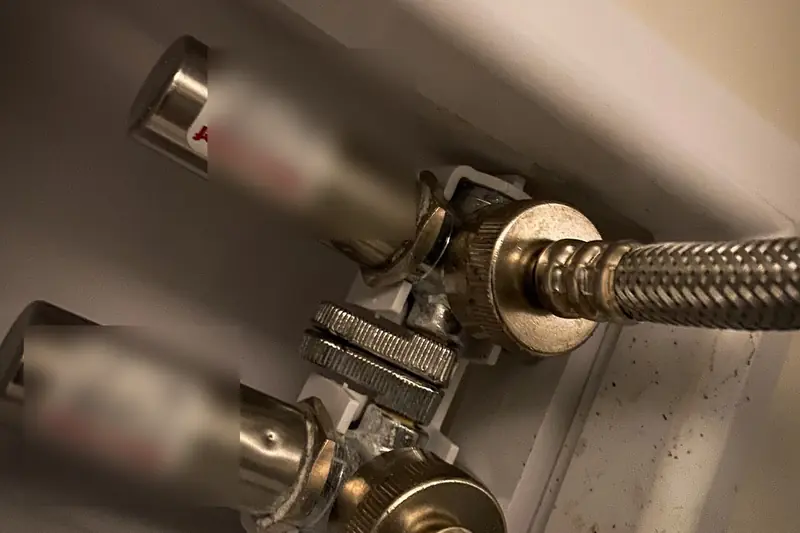
Water is heavy and it does not compress. Stop it short and that moving weight has nowhere to go, so the pipe takes the hit. Watts, a valve maker, puts it this way: the noise comes from shocks of high-speed water when a fixture is suddenly closed. In a shared building, the shock can travel, which is how you can hear a bang from a dishwasher two floors away.
When does it bang? That is the whole diagnosis
- When your own washer or dishwasher fills and stops: those use fast-closing valves. The plumbing code requires a water-hammer arrestor at quick-closing valves for clothes washers, dishwashers and ice makers, in the adoption read here, but an older hookup may not have one.
- When you shut a particular faucet quickly: try closing it slowly. If that quiets things, the fixture or the pressure behind it is involved.
- When nothing in your home is running: the source is someone else's appliance, or building equipment. Note the times and tell staff.
- All through a floor or the building: pressure may be too high, or a regulator may have failed.
- From a radiator or heating pipe when the heat comes on: that may be a heating system noise and not water supply at all, and it goes to staff.
- A tick or rattle as hot water runs: more likely a pipe moving against a strap or framing than true hammer.
What about pressure?
More pressure means more force behind every stop. Most codes cap static pressure at 80 psi, as EPA notes, and New York City's figure is 85. A pressure-reducing valve keeps a building or a section within the limit, and these can wear out over time. Staff or a plumber can tell you whether yours belongs to the building or serves your unit alone.
What does the fix look like?
For a washer or dishwasher, usually an arrestor at the hookup, which a plumber can often fit without much fuss. For a loose run, a strap or clamp, if the pipe can be reached. For pressure, a regulator repair or replacement by the building. Do not tie, wedge or hang anything on a sprinkler pipe to quiet it. Those are fire-code lines, and the sprinkler page explains why they are off limits.
Online advice about draining the whole system to restore air chambers is written for houses. In a shared building that means closing building valves and emptying lines that serve other homes, so it is not an option for a resident.
Banging alone is rarely an emergency. Banging plus dampness, a stain or a new drip is different: the ceiling leak first steps apply, and you should report it the same day.
If you own
An arrestor at your washer is probably your job, and worth doing if your machine is the source. For anything beyond your fixtures, ask the association to have pressure checked, and ask for the reading. Get a licensed plumber for any work in the wall, and tell the manager beforehand. See which valves are yours before anyone shuts anything off.
If you rent
Report it in writing, with times and what was running. Noise complaints tend to go further when they say which appliance or hour is involved, and there is nothing to fit or adjust on your side. If your own washer is the cause, say so, since an arrestor is a small repair for the landlord to arrange.
The short of it
Find out what is running when it bangs. Your own appliance usually means an arrestor, a building-wide noise usually means pressure, and both are jobs for a plumber or the building.
Asked next
Can water hammer damage pipes?
Repeated shock is not good for pipes and joints, which is why codes ask for arrestors in the first place. No source read here gives a figure for how much damage to expect. If it happens many times a day, it deserves a repair and not just tolerance.
Why did the banging start after the building did plumbing work?
Work can change pressure, leave air in lines or loosen a strap. Tell staff the date it started, since that may point them straight at the cause. A temporary rattle right after a shutdown may settle, but a lasting one should be reported.
Will closing a faucet slowly stop the noise?
It can quiet a fixture you control. It does nothing about appliance valves or a neighbor's habits, so treat it as a test rather than a repair.
Read it yourself
- Watts, LF15 water hammer arrestor sheet: what causes the noise, maker's product sheet, read Nov 3, 2026.
- International Plumbing Code 2021 as adopted by North Carolina, chapter 6: section 604.9 on arrestors and 604.8 on 80 psi, code text as displayed by a third-party code site, read Nov 3, 2026.
- EPA WaterSense, Service Water Pressure technical sheet: most codes at 80 psi, read Nov 3, 2026.
- NYC Plumbing Code 2022, chapter 6: the 85 psi figure, code text as displayed by a third-party code site, read Nov 3, 2026.