Why does my drain gurgle when a neighbor runs water?
Who pays, usually: A shared vent or slow common line is usually the association's or building's job. If the trouble proves to be only your own fixture's trap or branch, the owner or landlord may pick it up.
Filed under Probably the association's
A gurgling drain in an apartment usually means the line is short of air, often from a blocked vent or a slow shared drain, so passing water pulls air through your trap instead.
From the Whose Pipe Is It? desk. Sources last checked November 3, 2026. .
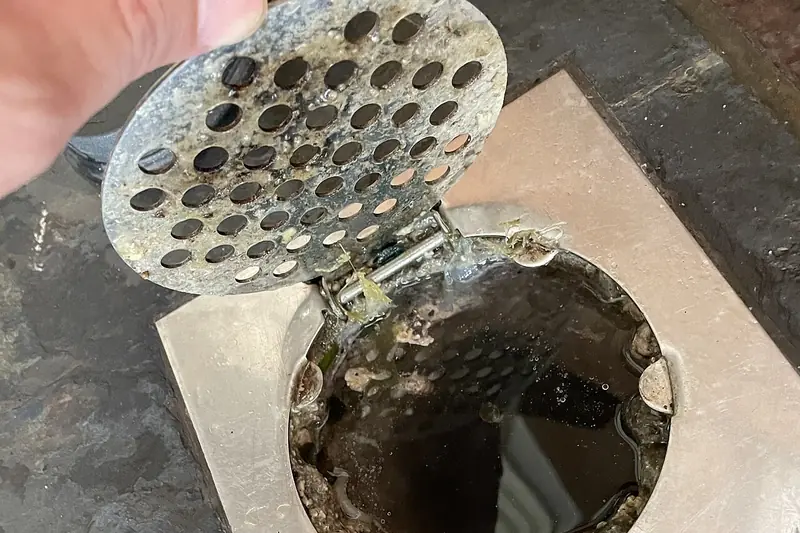
Water falling through a pipe needs air moving with it. Pipes are built for that: the plumbing code describes a system of vent piping that lets air in and out. When that air supply is short, a neighbor's flush or laundry load pulls what it needs from the nearest place, and that may be through the water in your trap. The glug you hear is air bubbling through it.
So a gurgle is a report about air. It usually means something is not quite right on the line, though it does not by itself mean sewage is on its way.
Why bother, if it is only a noise?
Because that trap water is what keeps drain air out of your home. Code text such as North Carolina's adoption asks for a trap seal between 2 and 4 inches, and repeated pulling can lower it. So gurgling and a sewer smell often turn up together. Wisconsin's health department names a leaking or blocked roof vent among the ways sewer gas gets in.
What should you notice before you report it?
Whoever takes this up will want answers to a few questions, so you might as well have them ready:
- Which fixture gurgles, and does it happen when your own water runs or only when neighbors' does?
- What time of day, and does it follow a pattern, such as a neighbor's laundry?
- Is the drain also slow?
- Is there a smell afterward?
- Does the water level in the toilet bowl rock or drop?
- Do neighbors above or below you hear it too?
A gurgle only when your own sink drains points toward your own branch or trap. A gurgle when your home is quiet points to the shared line. If a kitchen sink is also backing up, or foam shows up, as in suds in a low-floor sink, include that, because they are often pieces of the same problem.
What should you leave alone?
The roof, for a start. Vents usually run up through the building to the roof, and that is staff's territory, even though some home advice tells you to go up and look. Skip the drain chemicals as well. They do nothing for a vent, and a shared line is not a place to pour them. If water starts rising in a fixture, stop using your drains and call the building.
If you own
A vent serving more than one unit is very likely a common element, so report this to the association with your notes, and ask them to have a plumber look. If you have remodeled, or a previous owner did, mention it, since a changed vent can cause exactly this. A plumber's written finding can help settle who handles a single-unit problem.
If you rent
Tell the landlord in writing and describe the pattern. You should not need to arrange a plumber for this one. If a smell starts, say so right away, since that makes it a more pressing repair than a noise.
The short of it
A gurgle means a pipe is short of air. Note when it happens and whether a smell or slow drain comes with it, and let the building find the blockage.
Asked next
Is a gurgling toilet worse than a gurgling sink?
It is more worth reporting, since a toilet connects directly to the larger drain and can show trouble on the main line sooner. Watch whether the bowl level drops or bubbles. If it rises instead, stop flushing and call the building.
Can an air admittance valve fix a gurgling drain?
It is a one-way air valve some plumbers use under sinks, and whether it is allowed depends on your local code and building. It might help a single fixture, but it will not fix a shared line problem. That is a question for a licensed plumber and the building department.
Will running more water clear the gurgle?
Usually not, since it is an air problem. If the drain is slow as well, more water can add to the trouble. It is better to note the pattern and report it.
Read it yourself
- International Plumbing Code 2021 as adopted by North Carolina, chapter 9: vent piping and air, code text as displayed by a third-party code site, read Nov 3, 2026.
- International Plumbing Code 2021 as adopted by North Carolina, chapter 10: trap seal depth, code text as displayed by a third-party code site, read Nov 3, 2026.
- Wisconsin Department of Health Services, sewer gas: roof vent route, read Nov 3, 2026.