Why does my shower go cold when a neighbor uses water?
Who pays, usually: A valve in your wall that serves only your shower often falls to the owner or landlord, while a crossover elsewhere or a building-side fault usually goes to the association or building.
Filed under Not clear yet
Apartment shower temperature changes when someone else draws water usually mean your valve cannot balance a sudden pressure shift, or hot and cold water are crossing somewhere, and each cause has a different owner.
From the Whose Pipe Is It? desk. Sources last checked November 3, 2026. .
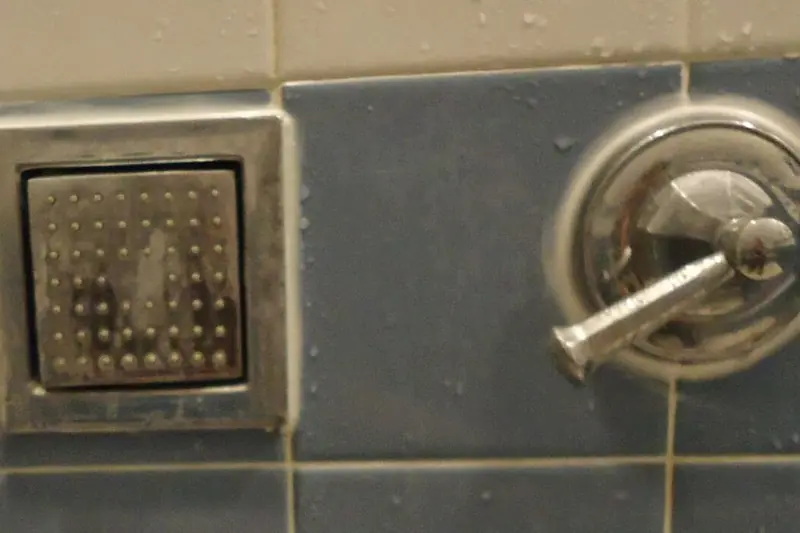
A cold blast is annoying. The hot blast is the one that hurts, and it is the reason this gets more attention than an ordinary nuisance. When the cold side of your shower suddenly loses pressure, the mix swings hot.
What is the valve supposed to do?
Inside your wall is a mixing valve. Modern ones hold the temperature steady in one of two ways. A balanced-pressure valve responds to pressure changes on either side, and a thermostatic one responds to the temperature of the mix. The plumbing code calls for one of those types on individual shower and tub-shower valves, with a means of capping the handle at 120 degrees. An older shower may have been put in before that was common, or the valve may have worn out, and either way it passes every pressure shift straight to you.
Which kind of swing do you have?
| What happens | Points toward | Whose it probably is |
|---|---|---|
| It swings when your own toilet flushes or your kitchen tap runs | Your valve is not balancing, or is worn | Often the owner or landlord |
| It swings at set hours, with nothing running in your home | Building pressure changes, or crossover | Usually the building, to investigate |
| It drifts steadily cooler and stays there | The heater or central supply is running short | Depends on where your hot water comes from |
| It never gets properly hot, and other taps are lukewarm too | Crossover somewhere on the line | Usually the building, to investigate |
| Flow drops but the temperature holds | A pressure question, not a valve one | Usually the building |
What does crossover mean, and why might it not be your fault?
It means cold water is finding its way into the hot pipe, or the reverse. A DOE-funded report places it at worn faucet mixing cartridges and at washer and dishwasher connections. On a shared line, the worn part could be several floors away, so it is a poor fit for one resident to solve. DOE's multifamily slides tell designers to use only ASSE 1016 valves with check valves built in. It also explains some long waits for hot water.
Can it be fixed without opening the wall?
Sometimes. A worn cartridge can often be swapped from the front through the trim, while replacing a whole valve body usually means opening tile or an access panel. Either way, this is plumber work in a shared building, because the water may have to be isolated first. If your shower has no stops of its own, that means asking staff to arrange a shutoff. See which shutoffs are yours.
If you own
A shower valve serving only your unit is often yours, but check the part of your declaration that defines the unit and read how it treats plumbing inside the walls. Tell the manager before the plumber comes, since the job may need a riser shut down. If your valve checks out fine, ask the association to look for crossover on the line.
If you rent
Report it in writing and say plainly that the water swings hot, because a scald risk tends to get a faster response than a comfort complaint. Do not replace the cartridge or change the limit stop yourself. Note the date you reported it and when anyone came.
The short of it
If your own fixtures set it off, suspect your valve. If it happens at odd hours or the whole line runs lukewarm, suspect the building. Treat any hot swing as a safety issue until it is fixed.
Asked next
Does an older shower valve have to be upgraded?
The code wording covers shower valves, but whether an existing old valve must be changed is a question for your local building department. Replacement work is the usual moment this comes up. Ask your plumber what your city expects before choosing a part.
Is a thermostatic valve better than a balanced-pressure one?
They solve the problem differently, and the code accepts either. A plumber can tell you which fits the existing valve body and your building's water. In a building with unsteady supply, ask them to explain the trade-offs for your shower specifically.
Could the limit stop be set too high?
It could. The limit stop is the adjustment inside many valves that caps how far the handle can turn toward hot. If your water is scalding at full turn, mention it, and let the plumber or landlord set it with a thermometer.
Read it yourself
- CPSC, water heater safety sheet 5098: exact scald times, read Nov 3, 2026.
- International Plumbing Code 2021 as adopted by North Carolina, chapter 4: shower valve types and the 120 degree limit, code text as displayed by a third-party code site, read Nov 3, 2026.
- DOE Building America, central domestic hot water report: where crossover happens, read Nov 3, 2026.
- DOE, efficient hot water distribution in multifamily buildings: ASSE 1016 valves, read Nov 3, 2026.