Why does hot water take so long to reach my apartment?
Who pays, usually: The association or landlord usually handles a central heater or hot-water loop. If the heater sits inside your unit, an owner may pay and a renter reports it.
Filed under Probably the association's
When hot water takes a long time to reach your apartment, the usual causes are a long run of cooled pipe, a recirculation loop not doing its job, or cold water crossing into the hot line.
From the Whose Pipe Is It? desk. Sources last checked November 3, 2026. .
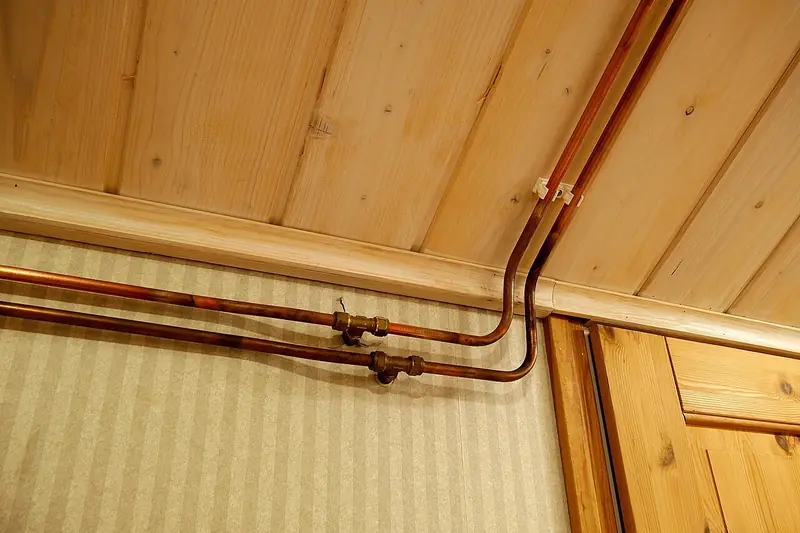
Before anything hot arrives, your faucet has to push out everything already sitting in the pipe. That water has gone cold, and the distance and pipe size decide how much of it there is.
For a sense of scale, EPA's WaterSense home standard aims for no more than 0.5 gallons between the hot water source and any fixture. Half a gallon at the 2.5 gallons a minute listed for a shower in the plumbing code's flow table takes about 12 seconds, by simple arithmetic. That is a new-home target, not a rule your older building has to meet. It does tell you that a wait of several minutes may be more than ordinary pipe.
Where does your hot water come from?
This is the question that decides nearly everything else. If there is a water heater in a closet in your home, the wait comes from your own run of pipe and it is probably much the same every day. If a central boiler or heater supplies the building, the water may be traveling a long way, and many such buildings keep it moving in a recirculation loop so that hot water is close to every riser. Your manager can tell you in one sentence which you have.
When a loop works, the wait is often short. When a pump has failed, a timer has it off for the night, or a branch is poorly balanced, water sits and cools and the wait grows. That is a general picture of how these systems behave, and only someone with access to the plant can confirm it.
What about water that stays lukewarm?
That points away from distance and toward crossover, where cold water pushes into the hot line. A DOE-funded report on central hot water says it happens at worn faucet mixing cartridges and at washing machine and dishwasher connections. In a shared building, the worn cartridge may be in someone else's home, which is why this can be slow to trace. To prevent it, DOE's multifamily guidance calls for ASSE 1016 valves that have built-in check valves. The same fault can show up as a shower that swings hot and cold.
Time it, so the complaint has numbers in it
- Pick a tap you use daily and start a timer as you open it fully to hot.
- Hold a cooking thermometer in a cup under the stream, keep your hand out of it, and stop when the reading stops climbing. Note the temperature.
- Repeat at the same hour on three mornings, then late in the evening.
- Ask a neighbor on your line to try the same thing.
- Send the times to the manager, and say whether the water reaches full heat or stalls at lukewarm.
A wait that swings wildly by time of day suggests the plant. A wait that never changes suggests distance. Neighbors with the same trouble make it a building matter, and the page on no hot water at all picks up if the water stops arriving.
Would turning the heater up help?
No. A hotter tank does not move water through the pipe any faster, and it raises the scald risk. CPSC urges all users to lower water heaters to 120 degrees, and DOE names the same setting. Gas water heater work belongs to a licensed pro, and a heater in a closet has its own rules.
If you own
A central loop is normally the association's, so bring your timings to the manager or the board. With a heater in your own unit, a plumber can look at your options. A recirculation line is one, though WaterSense mentions it as new-home guidance, and retrofitting one in a stacked building may need the association's approval.
If you rent
Report it in writing with your timings. Nothing this site has read sets a maximum wait for hot water, so frame the complaint around what you measured and how it has changed. A complete loss of hot water is a stronger issue, and the landlord's duties there vary by state.
The short of it
A short wait is geometry and a long one is usually a loop that is not looping. Time it for a few days, find out where your heat comes from, and let those two facts decide who hears about it.
Asked next
Why is the hot water instant on some days and slow on others?
Something is changing upstream, such as a pump on a timer, heavy demand at a set hour, or a fault that comes and goes. A consistent delay points to distance, while an inconsistent one points to equipment. Your written times will show which you have.
Can you add a recirculation pump to just one apartment?
Possibly, if your home has its own heater and the plumbing allows it, but that is a plumber's call. Tying anything into a shared central loop is the building's decision. Ask the association or landlord before you buy equipment.
Does running the tap while you wait waste much water?
It uses whatever is sitting in the pipe, every time, so the longer the run, the more goes down the drain. A bucket in the shower can catch some of it for plants or cleaning.
Read it yourself
- EPA WaterSense, labeled homes hot water: the 0.5 gallon target and demand-initiated recirculation, read Nov 3, 2026.
- International Plumbing Code 2021 as adopted by North Carolina, chapter 6: shower flow in Table 604.3, code text as displayed by a third-party code site, read Nov 3, 2026.
- DOE Building America, central domestic hot water report: where crossover happens, read Nov 3, 2026.
- DOE, efficient hot water distribution in multifamily buildings: ASSE 1016 valves with check valves, read Nov 3, 2026.
- CPSC, water heater safety sheet 5098: 120 degrees, read Nov 3, 2026.
- DOE, Energy Saver guide: the 120 degree setting, read Nov 3, 2026.