Water came through my condo ceiling from upstairs. Who pays?
Who pays, usually: Often several parties share it. Your own unit policy is the usual first call, and the source, any negligence, your declaration and state law decide what shifts to a neighbor or the association.
Filed under Not clear yet
With a leak from an upstairs condo, who pays is not automatically the upstairs owner: the source, negligence, your declaration, state law and two or three insurance policies decide it, piece by piece.
From the Whose Pipe Is It? desk. Sources last checked November 3, 2026. .
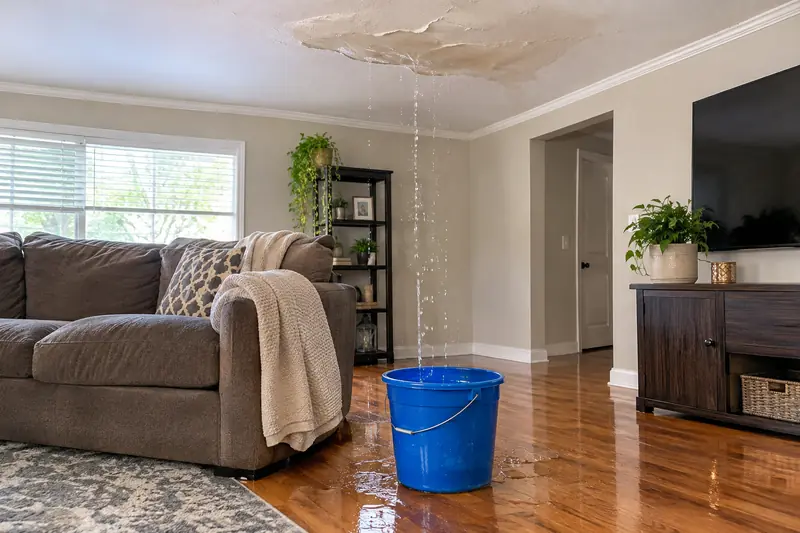
There isn't one bill here. There are several, and they can land in different places. The upstairs owner may owe nothing, or may owe part of it, and your own insurer may pay you first and argue about it later. So the useful question isn't "who pays" but "who pays for which piece".
What are the separate pieces?
- The pipe or part that failed. Pipes serving more than one unit are usually common elements. Lines and fixtures serving one unit vary by declaration, so working out which pipes are yours comes first.
- Opening and closing the ceiling. Often tied to the same maintenance article, but not always the same answer as the pipe.
- Drywall and structure. Usually a question of what the master policy covers.
- Paint, flooring, cabinets and upgrades. Depends on how far the master policy reaches into the unit.
- Your belongings. Normally your own unit-owner policy, whoever caused the leak.
- A place to stay. Sometimes covered by the loss-of-use part of your policy, if you have it.
- The master policy deductible. It may be shared, or it may be charged to you. See the page on deductible charges.
How far does the master policy reach?
Washington's insurance regulator describes three common types, set by the governing documents. All-in covers interior finishes. All-in excluding improvements covers the unit as originally finished, not your upgrades. Bare walls stops at the uncovered sheetrock and subfloor. Find out which you have, because it moves the line between the association's claim and your HO-6. Owners there get a Certificate of Insurance each year showing limits and the deductible, and it is a good document to ask your manager for.
Does where the water started change things?
A lot. These are common patterns, not rules. Your documents and your state can change any row.
| Source | What often follows | What to look at |
|---|---|---|
| Shared riser or stack | The association usually handles the pipe; interior damage still runs through the insurance split | Definition of common elements, insurance article |
| Neighbor's negligence, such as an overflowing tub | Your HO-6 typically covers what the master policy doesn't, and your insurer may pursue the neighbor's liability cover | Your policy, any water-escape clause in the declaration |
| A part serving only the upstairs unit, with no sign of neglect | Not automatically the neighbor's cost | Maintenance article, state statute |
| A slow leak that ran unnoticed | Gradual leaks are often outside coverage, so a claim may be refused | The water damage wording in each policy |
Neglect is a judgment, and an insurer or a court makes it, not the neighbor in the hallway. If the upstairs owner was on the other side of the same event, they may be reading the same question from the other side.
What should you do this week?
Getting it onto paper
- Report it to the manager or association in writing, with the date and photos.
- Open a claim with your HO-6 insurer for your belongings and anything the master policy won't cover.
- Ask the manager for the plumber's finding on the source, and whether a master policy claim is being made.
- Get the declaration, bylaws and Certificate of Insurance. Your insurer will likely need them too.
- Keep a log of calls, invoices and receipts. Start drying now rather than waiting for the answer.
If you own
Start with the definition of unit and common elements, and go on to the maintenance and insurance articles. If real money is at stake or the association refuses a claim you think is valid, ask your insurer and a lawyer licensed in your state.
If you rent
Most of this is your landlord's fight, not yours. Your concern is your belongings and your lease. The renter's version of this question is the one to read.
The short of it
Expect the damage to be split rather than billed to one person. Call your own insurer early, get the source in writing, and let the documents and adjusters sort out the rest.
Asked next
Can the upstairs owner just be sent the bill?
You can ask, but they may not owe it. Their responsibility usually depends on the cause, negligence, your declaration and state law. Handing the claim to your own insurer is often cleaner, since it may seek repayment from the neighbor's liability cover.
Why would your insurance pay when it wasn't your fault?
Your policy covers your loss, and fault gets argued afterward. Your insurer may try to recover what it paid, and you can ask whether that would include your deductible. Waiting for a neighbor to agree could leave your ceiling wet.
The upstairs owner has no insurance. Now what?
Your own policy still applies under its terms, and whether you can collect from an uninsured neighbor is a legal question. A lawyer in your state can say whether it is worth pursuing. Some declarations require unit-owner cover, so check the insurance article.
Must you use the association's contractor?
Ask, because it depends on who is repairing what. The association usually controls work on anything it insures or maintains. For work in your unit that your own policy pays for, ask your insurer before you commit to anyone.
Read it yourself
- Washington Office of the Insurance Commissioner, Filing a condo unit insurance claim: neighbor negligence, recovery from liability cover, documents, adjusters, deductibles, read Nov 3, 2026.
- Washington Office of the Insurance Commissioner, How condo insurance works: the three master policy types and the annual Certificate of Insurance, read Nov 3, 2026.
- Washington Office of the Insurance Commissioner, Leaks, water damage and mold: sudden and gradual leaks, read Nov 3, 2026.
- Florida Statutes 718.111: deductibles, chargeback and opt-out, Florida only, read Nov 3, 2026.
- 765 ILCS 605/12: board options on the deductible, Illinois only, archived copy of the official page, captured May 22, 2025, read Nov 3, 2026.
- Maryland Insurance Administration, condominium FAQs: deductible by origin, Maryland only, archived copy of the official page, captured June 8, 2026, read Nov 3, 2026.