I rent, and water came through the ceiling. Who pays for my things?
Who pays, usually: Your own renters insurance usually pays for your belongings, because a landlord's policy doesn't cover them. The landlord generally handles the building, under your lease and state law.
Filed under You rent: start with your landlord
Renters insurance is usually what pays for water damage to your things after a ceiling leak, because the landlord's policy covers the building and not your couch, clothes or laptop.
From the Whose Pipe Is It? desk. Sources last checked November 3, 2026. .
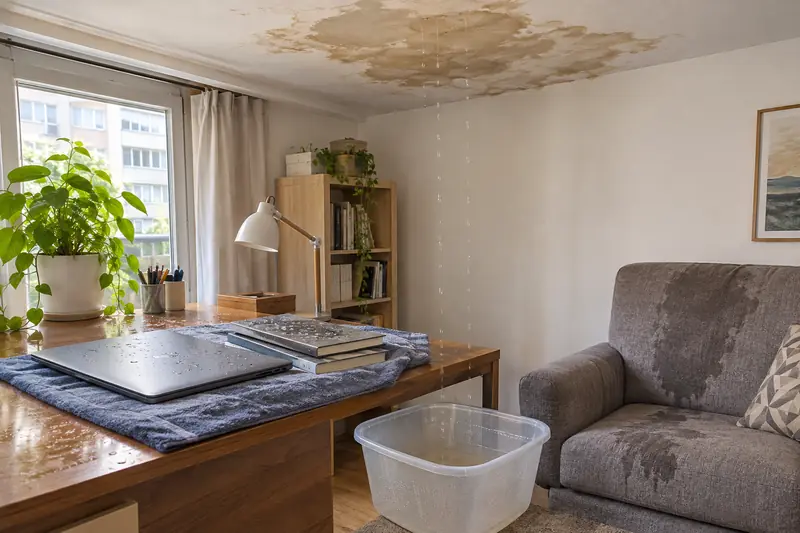
People are often surprised by this. The ceiling is your landlord's problem, and the couch underneath it is yours, even when you did nothing wrong. The National Association of Insurance Commissioners says it plainly: your belongings aren't on a landlord's policy. California's insurance department says the same.
That holds whether you rent from a big management company or from one owner of one condo. In a condo, your landlord deals with the association, and you deal with your landlord.
If you have renters insurance
Most policies pair two basic coverages, personal property and liability. Some add living expenses if you can't stay in the apartment because of an insured loss. Texas's insurance department says sudden, accidental water damage is covered by most home and renter policies, while gradual leaks usually aren't. A pipe that lets go overhead is a much easier claim than a stain that has been spreading for months, though your own wording decides.
Making the claim
- Photograph or video everything where it sits, before you move it far.
- Send your landlord a dated message with the photos. Call your insurer as soon as you can.
- List what was damaged. Add model and serial numbers for electronics where you can read them.
- Move wet things to a dry room, and if they go outside, keep them secure. Leave anything near a wet outlet or light until the building says it's safe.
- Keep the damaged things until the adjuster has seen them, even the ones you plan to throw away.
- Keep receipts for anything you buy to prevent further damage, and for any extra living costs.
One thing to check when the check arrives. Actual cash value pays what an item was worth at the time of the loss, less depreciation and your deductible. Replacement cost coverage is different, so look at which one your policy lists. A five-year-old laptop may not bring a new laptop's price.
If you don't have it
Your landlord's policy still won't step in for your things. Whether someone owes you anyway is a separate question, and it depends on what caused the leak, whether anyone was negligent, your lease and your state's law. If the landlord ignored an earlier report of the same leak, that can matter, so gather your old messages. For anything sizable, a tenant lawyer or legal aid office in your state can say whether you have a claim.
What is the landlord responsible for?
Generally, the building: the ceiling, the plumbing and getting the leak fixed, according to your lease and state law. If that stalls, what to do about a landlord who won't fix a leak goes through the options. And if the leak has only just started, the first-hour page comes first.
If you own
If you rent the unit out, your HO-6 or landlord cover is about your property and interests, not your tenant's belongings. Respond to the report quickly and pass it to the association if the source may be a shared line. The condo owner's version covers your side.
If you rent
Report in writing and claim on your own policy if you have one. If it came from your own unit, the page on leaks into the unit below applies, and the liability part of your policy is the one to ask about.
The short of it
The building is generally your landlord's job, and your things are generally your policy's job. Photograph it, put it in writing, and keep the damaged items until someone has seen them.
Asked next
The landlord blames the upstairs tenant. Who is responsible for your things?
Start with your own insurer, if you have one, and let it decide whether to pursue anyone. If you are uninsured, the cause and any negligence decide whether that tenant or the landlord owes you, and that is a question for a lawyer. Your landlord remains your contact for the repair itself.
Will insurance pay for a hotel?
It might, if your policy includes loss of use and the apartment is unlivable because of a covered loss. New York's guide says you are generally covered for the difference between normal and increased living costs. Call before you book if you can, and keep every receipt.
Does renters insurance cover mold on my things?
Only in limited ways. Texas's guidance says mold on an item damaged by a covered water loss would be covered, but mold from gradual leaks generally isn't. Check your own policy and dry things quickly.
Would buying renters insurance now cover this leak?
Assume not. Insurance is for losses that happen after it begins, and an agent will ask about existing damage. Buying now still makes sense for the next leak, which may well come from the same ceiling.
Read it yourself
- NAIC, Renting your home: landlord's policy and your belongings, basic coverages, actual cash value, archived copy of the official page, captured June 16, 2026, read Nov 3, 2026.
- California Department of Insurance, Residential Insurance guide: landlord does not insure your property, read Nov 3, 2026.
- New York DFS, Homeowners and tenants insurance guide: tenants policies and increased living expenses, read Nov 3, 2026.
- Texas Department of Insurance, When are water damage and mold covered: sudden and gradual leaks, mold, claim steps, read Nov 3, 2026.
- Washington Office of the Insurance Commissioner, Filing a condo unit insurance claim: serial numbers, receipts, read Nov 3, 2026.
- California Civil Code 1941.1: habitability standards, California only, archived copy of the official page, captured Sept 14, 2026, read Nov 3, 2026.
- California Civil Code 1942: repair and deduct limits, California only, archived copy of the official page, captured Sept 25, 2026, read Nov 3, 2026.
- Texas Property Code chapter 92: sections 92.056, 92.0561 and 92.058, Texas only, read Nov 3, 2026.